



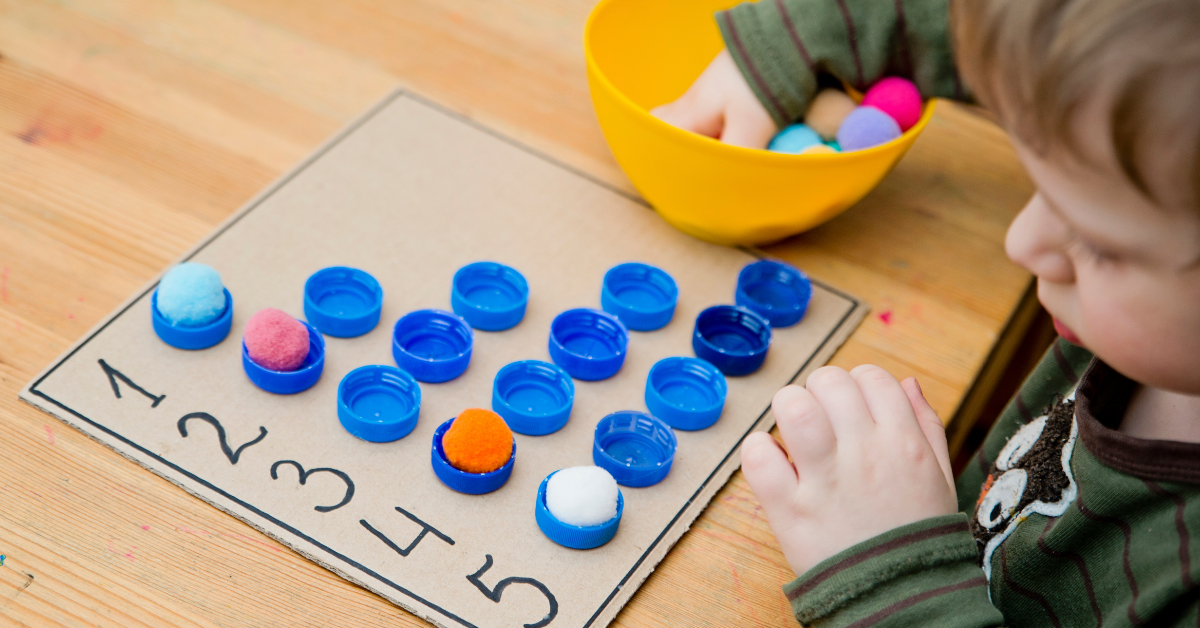
For a preschooler, numbers on a page can feel like a mystery. But when a child stacks, sorts, or touches math materials, abstract ideas suddenly come to life.
That’s the power of sensory math: transforming confusing symbols into experiences kids can see, touch, and enjoy.
Young learners, who naturally explore their world through their senses, often struggle when math is presented only in conceptual form. Tactile learning bridges this gap by making early math concepts concrete and accessible. Sensory play activities keep early education students engaged with fun and effective activities, creating neural connections that strengthen understanding and recall.
When children work hands-on with materials like Early Learning Blocks and other manipulatives, they develop:
- Number sense and counting skills
- Spatial reasoning abilities
- Problem-solving foundations
- Physical and cognitive connections to math learning
The Build-Write-Say methodology, central to programs like Math-U-See, is designed to leverage these principles from the very beginning.
Why Sensory Math Works
The link between physical touch and brain development is powerful. Engaging in kinesthetic learning through sensory play activates multiple areas of children’s brains simultaneously. This multisensory approach creates stronger neural pathways and supports long-term mastery.
Research-Backed Benefits
Studies, including research from the University of Illinois, show that tactile and haptic feedback significantly enriches learning across a wide developmental range. Engaging multiple senses allows children to process information through different channels all at once, deepening their understanding.
Touch also uniquely reinforces memory of numbers and patterns. For example, when a child manipulates blocks or counters, signals from their hands combine with visual input to create stronger conceptual connections than visual learning alone. This embodied approach reveals that movement and touch are essential to mathematical thinking.
Beyond retention, sensory math also impacts how children feel about learning.
Building Confidence Through Touch
Sensory math reduces frustration and builds confidence. Students who struggle with worksheets often thrive when they can physically manipulate math materials. The Build-Write-Say methodology ensures multiple pathways to mastery: building with manipulatives, writing solutions, and verbalizing the thinking processes.
Key Benefits of Hands-On Math Activities
Hands-on math activities help children connect with numbers in meaningful ways. When kids can see, touch, and move objects, that’s when the shift from conceptual symbols to real, memorable experiences occurs. Kids experience:
- Concrete Understanding: Abstract ideas become visible and tactile when kids physically combine manipulatives to solve math problems like 3 + 2 = 5
- Sustained Engagement: Hands-on math activities keep interest high through interactive play
- Improved Fine Motor Skills: Manipulating physical sensory materials strengthens hand muscles while reinforcing math comprehension
- Greater Confidence: Physical demonstration provides immediate, visible proof of accomplishment
By combining movement, play, and problem-solving, hands-on activities give children a strong foundation for future learning.
Practical Sensory Math Activities
These math activities work equally well in classroom settings and at home, with a simple setup using hands-on materials as an ideal foundation.
Counting with Blocks and Sensory Bins
Invite children to stack Math-U-See Integer Blocks or other manipulatives while counting aloud. Create sensory bins filled with objects for counting practice. Items like dried beans, water beads, or craft sticks tend to work well. Progress to skip counting by twos or fives using these materials, which will help reinforce number relationships while engaging multiple senses.
Sorting and Patterns
Gather items with various textures, like smooth blocks, rough sandpaper, soft play-dough shapes, and bumpy shells. Sorting these materials into groups while describing their properties builds classification skills through tactile experiences. Use the same items to create repeating patterns, which keeps learners engaged while reinforcing predictability in math.
Build Shapes and Compare
Encourage children to construct towers using blocks and craft sticks, then compare which is taller, shorter, or equal. You can also ask your budding mathematicians to build shapes and solve spatial problems by using measuring cups to explore volume concepts with water or sand.
Math Operations with Interactivity
Use manipulatives to act out problems. “Three bears went to the forest (place three unit blocks), two more joined them (add two unit blocks). How many bears are in the forest now?”
Teaching Fractions and Multiplication
Play-dough is ideal for teaching fractions. Children can form shapes and then divide them into halves, thirds, and quarters. For multiplication, group objects in sensory bins or use graph paper to visualize arrays. These tactile approaches make abstract operations more concrete.
Using Sensory Math to Teach Beyond Numbers
Sensory math activities don’t stop at counting and operations. Research on embodied mathematics has shown that physical interaction supports memory as well as complex mathematical understanding. By combining these insights with hands-on play, children strengthen skills that extend well beyond numbers.
Advanced Skill Development
Shapes and Spatial Reasoning: Children can be introduced to concepts of geometry by feeling the edges and vertices of blocks, building shapes with play-dough, and creating patterns with different forms through sensory play.
Creative Thinking and Problem Solving: Present construction challenges like “Build a bridge with Integer Blocks that can hold five more blocks.” Tasks like this require planning, testing, and revising strategies, which encourage flexible thinking and resilience.
Language Development: As children describe textures, quantities, and spatial relationships, they build mathematical vocabulary. This language development provides essential scaffolding for future success.
Making Sensory Math Simple at Home or in the Classroom
Creating effective sensory math experiences doesn’t require elaborate materials or expensive tools. Everyday objects can serve as powerful teaching aids that build connections between students and math concepts.
Using Everyday Materials
While Demme Learning’s manipulatives offer an ideal structure, these materials support math practice too:
- Buttons and water beads for counting and sorting
- Dried beans and measuring cups for estimation games
- Play-dough for teaching fractions and shapes
- Craft sticks and graph paper for visual patterns
- Natural items in sensory bins for exploration
Keeping It Fresh and Fun
Rotating Activities: Introduce new sensory play ideas each week. Math activities that use plastic blocks one week might lead to the incorporation of play-dough the next, maintaining interest while reinforcing concepts.
Student-Created Games: Encourage children to invent their own sensory math games using common sensory materials. When they design activities themselves, they take ownership of learning and develop problem-solving skills in the process.
Building Mathematical Foundations Through Touch
Instructors and parents alike see how sensory learning impacts student success, and research confirms that tactile methods enhance mathematics achievement.
By stacking blocks, shaping dough, or sorting everyday objects, children turn abstract symbols into experiences they can see and feel. Programs that emphasize hands-on strategies show that true mathematical mastery comes through experience rather than memorization. Demme Learning’s Build-Write-Say approach ensures that children can demonstrate understanding of math concepts in multiple ways.
Whether at home or in the classroom, hands-on math activities give young learners a joyful entry point into mathematics. When children discover that numbers can be touched, moved, and explored, math becomes less of a mystery and more of an adventure.
Ready to bring sensory math into your classroom or home? Download our early learning math printable to get started with fun, engaging activities that make numbers come alive for your young learners.
Download the Printable


Leave a Reply