



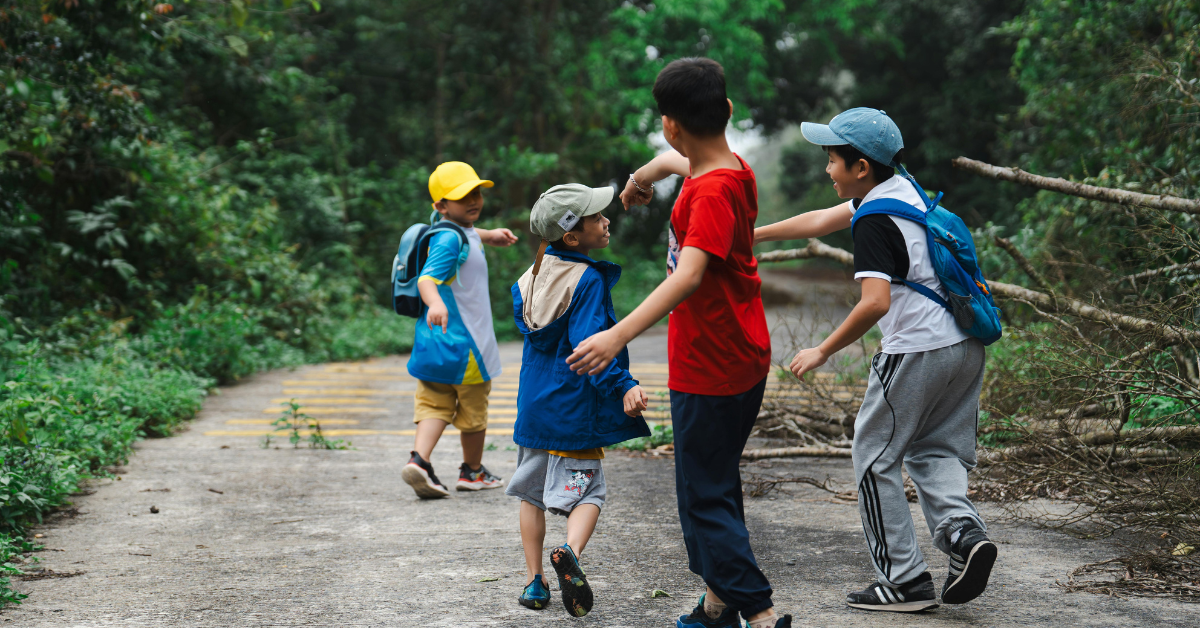
A family road trip through a national park may not look like a math lesson at first. There are trail signs to read, overlooks to reach, water bottles to ration, and wildlife sightings to count.
Before long, however, it’s not unusual to find kids comparing distances, estimating time, measuring elevation, and asking practical questions that depend on numbers.
The National Park System is an incredibly useful setting for math. National parks give students a reason to use arithmetic and record information in a place where every question has a clear purpose.
For homeschool instructors, classroom instructors, and parents, a park visit can be a hands-on way to show how math appears in everyday life while keeping summer learning active, practical, and memorable.
Why Nature is the Perfect Place to Learn Math
Outdoor settings make abstract ideas easier to understand because students can connect a number to something they see and feel. Distance becomes the trail ahead, while rate affects how long it will take to reach the next stop. Geometry appears in arches, tree rings, ridgelines, and rock walls.
Try using a few direct questions to help guide student effort:
- What can be counted here?
- What can be measured?
- What can be estimated first and checked later?
- What numbers would help the group make a better decision?
Structure supports mastery learning. It reinforces the need for students to think carefully, explain what they notice, and revise when needed.
Geometry in Nature
Natural landscapes provide steady examples of shapes, angles, symmetry, and repetition.
Students can spot balance in rock formations, compare the angles of mountain peaks, and sketch repeated forms in leaves, flowers, and cone scales. Older students can identify branching patterns in roots or cracked stone, which gives them a simple way to discuss fractal-like repetition.
Try these prompts to help students connect with their surroundings:
- Find circles, triangles, or curved lines along the trail.
- Compare two angles in a rock face or ridgeline.
- Sketch one repeated pattern from a plant or formation.
- Discuss how slope or shape helps a landform hold together.
- Look for examples of the Fibonacci sequence in plants.
Students who need more visual practice with outdoor patterns may also benefit from ideas collected in our guide to learning math through nature. And when exploration turns to circles, curves, and circumference, our related piece on recognizing Pi in everyday life offers some helpful connection points.
Measurement on the Move
Hiking brings travel math to almost every waypoint. Trail signs often provide mileage and elevation gain, which gives students immediate information to use.
Have students attempt related equations found along their journey:
- Calculate round-trip distance
- Estimate hiking time based on pace
- Convert miles to kilometers or feet to meters
- Compare two trails and determine which climb is steeper
Instructors can use official park maps and elevation charts to design individual or small-group outdoor math activities grounded in real spaces. Simple trail questions can become practical word problems, especially for upper-elementary and middle-school students who are ready to calculate distance, pace, and elevation change.
Math in Wildlife
Wildlife observation provides a strong entry point for data, estimation, and statistics.
Students can tally sightings, sort them by species, and calculate averages over a set period. They can also compare size, speed, or habitat notes from park materials or field guides.
Establishing a set of repeatable steps can help students easily incorporate math into any setting:
- Tally each sighting.
- Note the time and location.
- Sort animals by type.
- Compare patterns before moving on.
Younger students can focus on counting and comparing, while middle grades can calculate totals and averages. Older students can graph their recordings and discuss why a short observation period does not offer a full picture.
Real-Life Budgeting During a National Park Trip
A park visit includes applied math before anyone even reaches the entrance gate.
Students can compare routes, estimate gas costs, account for park fees, plan food spending, and calculate the total cost of the day or weekend. Try giving students a fixed amount and ask them to plan a family trip that stays within it. They can compare mileage, entrance fees, campground costs, meal options, and stop lengths.
For similar ways to connect number work to daily decisions, we also encourage instructors to reference our other recent piece that explores examples of real-life math.
Estimation in Action
Estimation activities belong in every math routine because they help students make a careful first judgment before checking a result.
When visiting a national park, ask them to guess the height of a rock formation, the width of a valley, or the distance to a viewpoint. Then compare their estimates to the posted or measured value and discuss what shaped their initial guesses.
Trees of any size can also present opportunities to engage young estimators. Measure the circumference, make a rough age estimate, and then discuss why that number is only an approximation. Water features can offer additional options. Students can time how long it takes water to move between two visible points in a narrow channel, or compare intervals between geothermal events.
The National Park Service records all major eruptions of the Steamboat Geyser at Yellowstone National Park annually. These figures offer older students real numbers to use for averages, ranges, and comparisons.
Turning Exploration Into a Math Routine
A national park visit does not need to become a formal math assignment to support real learning. A few subtle, but intentional, questions at trail markers, overlooks, visitor centers, and even picnic tables can help students connect numbers to what they are already seeing and doing.
Try building the day around a simple “one-stop math” routine. At each major stop, ask students to complete one quick math task:
- Record one distance.
- Make one estimate.
- Count one set of data.
- Ask one new question.
It might mean estimating how long it will take to reach the next overlook, counting the number of switchbacks on a trail map, or tracking how many birds, insects, or animal tracks they notice in five minutes.
A journal or printable log helps keep these small moments connected. For example, the National Park Service’s Passport To Your National Parks program has encouraged visitors to collect dated ink stamps at visitor centers and park stores for decades. Each stamp marks a stop on the trip, but it can also mark a math moment where students recorded a measurement, checked an estimate, or solved a problem.
For more ways to make math feel purposeful rather than forced, see our guide to fun math activities.
Adapting Activities for Different Ages and Skill Levels
National parks are particularly useful for mixed-age groups of varying skill levels because a single park stop can support several levels at once.
Younger students can count, identify shapes, and compare distances; middle schoolers can practice multiplication, estimation, and unit conversion; and older students can work with rates, data analysis, and written reasoning.
Because they’re applying these concepts to the world around them, the lessons are more meaningful, and practice is more memorable.
Summer Math That Stays With Students
Trying new summer activities helps keep math skills active during the break while giving families a shared experience they can enjoy together. Intentional, hands-on practice also reduces reliance on traditional worksheets and gives students more chances to connect math to places they will remember.
That’s why national parks work so well for reinforcing mathematics. Students use math to answer questions that matter in the moment.
If a trip can teach measurement (trail distances), tracking (wildlife sightings), calculating (trip budgets), and comparing (geyser records), and still deliver an enjoyable time for everyone, that’s a trip worth taking.
Ready to take math on the trail? Download Demme Learning’s printable Junior Ranger Math Log and kick off your summer full of fun and engagement!



Leave a Reply