



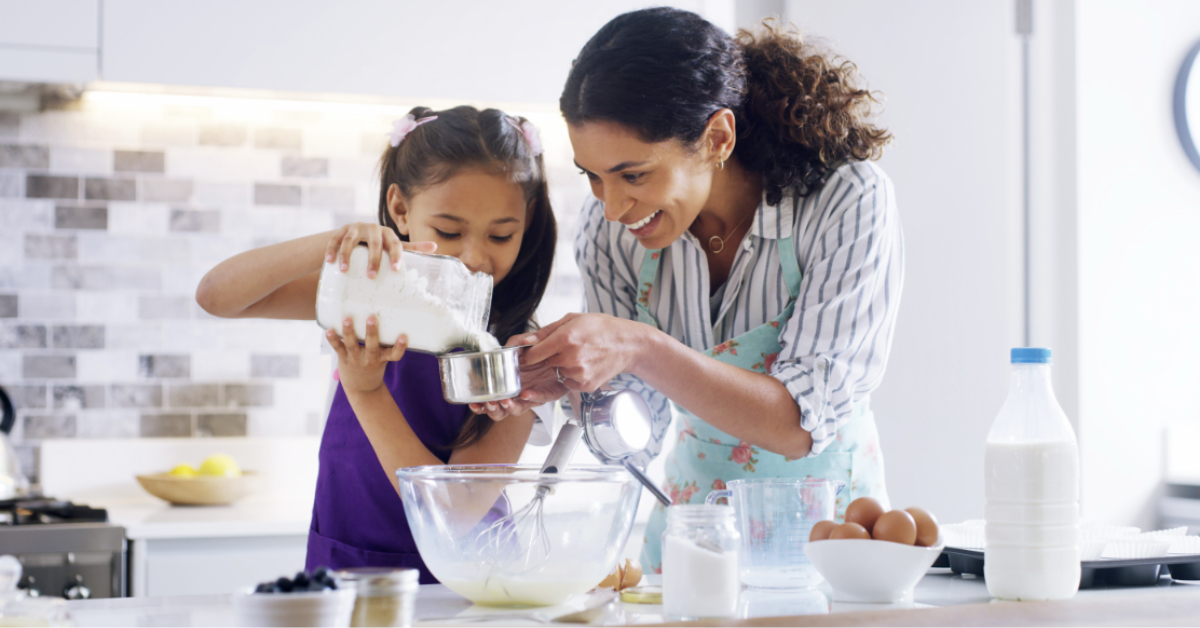
Fractions take on new meaning when students trade pencils for measuring cups and turn math into something they can mix, stir, and taste.
Doubling and halving recipes turns math into a hands-on experience filled with sights, smells, and even tastes. Numbers become ingredients to measure and enjoy — making fractions both memorable and meaningful. Teaching fractions through cooking offers one more way to bring mathematical concepts to life, complementing the strategies teachers already use in the classroom.
Research suggests that students who learn fractions through hands-on activities like cooking develop stronger math skills and retain concepts longer than those who use only paper and pencils for practice. They see immediate results from their calculations. Too much flour makes cookies crumbly. Not enough sugar leaves them bland. These natural consequences create memorable learning moments that stick with students far beyond any single lesson.
Why Cooking Works So Well for Teaching Fractions
Cooking naturally incorporates fractions at every turn. Measuring ½ cup of sugar or ¼ teaspoon of salt turns intangible numbers into something students can hold, smell, and taste. This concrete experience helps learners understand fractions, made simple through real-world application. Students will better learn to compare fractions when deciding whether to use half or one quarter of an ingredient.
Seeing how math works in the kitchen also helps students understand its purpose beyond the typical instruction.
Hands-on math instruction significantly improves understanding because, according to the National Council of Teachers of Mathematics, it leads to deeper conceptual knowledge of the relationships between numerator and denominator.
How to Double and Halve Recipes: A Step-by-Step Guide
Doubling and halving recipes gives students practice with multiplication, division, and fraction sense. Use these steps to guide them through the process with confidence.
Step 1: Start with the original recipe. Have students write down the list of ingredients with their exact measurements.
Step 2: Choose the operation. If doubling, multiply each measurement by 2. If halving, divide each measurement by 2.
Step 3: Do the math carefully.
- Whole numbers: Doubling 2 cups becomes 4 cups.
- Fractions: Halving ⅔ cup means dividing ⅔ by 2, which equals ⅓ cup.
- Mixed numbers: Doubling 2½ cups means doubling the whole number (2 → 4) and doubling the fraction (½ → 1), for a total of 5 cups.
Step 4: Simplify or convert. Encourage students to write answers as mixed numbers when appropriate. For example, 3/2 can also be written as 1½. This helps them see the relationship between improper fractions and mixed numbers.
Step 5: Double-check your results. Students can compare amounts by pouring ingredients into measuring cups or checking with a partner to confirm their calculations.
Common Mistakes When Working with Fractions in Recipes and How to Avoid Them
Students often double the main ingredients but forget the other ones. For example, a student might double the flour and sugar, but forget to double the eggs and milk, which results in a recipe that doesn’t turn out as expected. Create a checklist system where students write each ingredient and mark off calculations as they determine the new amount. Taking a systematic approach prevents oversights.
Another frequent error involves misreading measurements. Students confuse ⅛ and ¼ teaspoons or mix up tablespoons and teaspoons. Using proper measuring techniques and understanding the difference between measuring tools helps prevent these mistakes. One student might need extra practice with quarters and halves before moving to more complex fractions, while another might struggle to compare fractions or double a mixed number without making calculation errors.
Watch for calculation errors when working with mixed numbers and improper fractions. If students struggle, encourage them to use fraction models or manipulatives to visualize the problem before recalculating. Working in small groups to check each other’s math not only helps catch mistakes but also builds discussion around different solution strategies.
Fun Fraction Activities for the Kitchen Classroom
These fraction games and fraction activities for kids take abstract concepts and turn them into engaging experiences.
Pancake Fraction Flip is a fun activity that engages the whole class in a delicious math challenge. Have students double and halve a basic pancake recipe, then compare batter amounts using measuring cups. After calculating, groups can cook and ‘flip’ mini pancakes to check their math in real time. If the recipe was doubled correctly, they’ll end up with twice as many pancakes to flip. This visual and hands-on process reinforces the relationship between fractions and their scaled versions (just remember to invite plenty of hungry friends!).
Cookie Math Challenge turns fraction practice into a friendly competition. Working in teams, some students halve a cookie recipe while others double it, then compare amounts and results. This side-by-side comparison highlights how fractions scale up or down, and the mathematical discussions that emerge naturally support peer learning and build confidence with fractions in higher math.
No-Bake Fraction Treats make it easy to practice halving and doubling without kitchen equipment. Students can create trail mix, energy bites, or parfaits by scaling ingredient amounts up or down to match a given recipe. This type of hands-on scaling reinforces fraction skills in a practical way. Research on fraction learning shows that repeated practice in varied contexts improves long-term retention, and studies confirm that manipulative-based fraction instruction significantly outperforms traditional methods.
Recipe Card Rewrite develops both mathematical and communication skills. Students receive a recipe and rewrite it for half and double portions, showing their work and explaining their reasoning step by step. This activity works equally well for classrooms, homeschool settings, and co-ops, since it only requires a recipe card, paper, and pencils. By focusing on halving or doubling, students practice applying fractions in a clear, written format that reinforces both accuracy and explanation.
Taking It Further: Adapting Recipes for Different Serving Sizes
Once students master doubling and halving, introduce more complex scaling challenges.
If your students have a recipe for 12 brownies but only have enough ingredients to make eight, they’ll need to calculate the reduced amounts for each ingredient. This type of real-world adjustment is an early example of proportional reasoning, a skill that students will continue to use in advanced math such as algebra and geometry.
Working with unusual multipliers like ⅔ or 1¼ pushes students beyond simple doubling and halving. For example, if a recipe calls for ¾ cup of milk and you need only ⅔ of the recipe, multiply ¾ × ⅔ = 6/12, which simplifies to ½ cup. Similarly, if you need to scale ½ cup of sugar by 1¼, multiply ½ × 5/4 = 5/8 cup. Showing these steps helps students see how both numerators and denominators are involved in fraction multiplication.
Instructors can adopt real-world resources, like guides that show how recipes change for different pan sizes, to create classroom challenges. For younger students, this might mean comparing how a recipe changes when baked in a square pan versus a rectangular one. Older students can take it further by using digital scales to measure ingredients by weight, adding practice with decimals alongside fractions.
Building Confidence Through Kitchen Success
The beauty of teaching fractions through cooking extends beyond mathematical understanding. Students develop problem-solving skills when recipes need adjustment and they practice precision when measuring ingredients with equal parts. Most importantly, they experience the satisfaction of creating something delicious through mathematical thinking. This approach helps students see how fractions are an important part of the foundation for practical math applications.
These activities also support mastery-based learning. Teachers can observe progress as students move from halving simple whole-number measurements to doubling or reducing more complex mixed numbers. Having students explain their reasoning, compare solutions with peers, or record their calculations on recipe cards provides clear evidence of growth. Each successful adjustment builds confidence and reinforces the skill before moving on to the next challenge.
Most importantly, kitchen fraction activities work equally well in classrooms, homeschools, and co-ops. Even in settings where food isn’t allowed, instructors can adapt the activities by using dry measuring cups with beans, rice, or even paper recipe cards. Students still practice halving and doubling ingredients in a safe, accessible way that builds confidence and supports fraction division success.
Ready to make fractions come alive in your classroom or homeschool? Download our free printable Fraction Recipe Activity and discover more hands-on resources that make math meaningful for every student.



Leave a Reply