
• Skip to primary navigation
  • Skip to main content
  • Skip to primary sidebar
  • Skip to footer
  • Demme Learning
  • Math-U-See
  • Spelling You See
  • Analytical Grammar
  • WriteShop
  • Store
  • Digital Toolbox
Demme Learning

Demme Learning

Building Lifelong Learners

  • Search

  • Sort by

  • Category

Customer Service: M-Th 8:30am - 6pm ET
Live Chat • 888-854-6284 • Email

Shop Now
  • Home
  • About
    • Philosophy
    • History
    • Company Culture
    • Careers
  • Products
    • Math-U-See
    • Spelling You See
    • Analytical Grammar
    • WriteShop
    • Building Faith and Family
    • KinderTown
  • Blog
  • Guild
    • Math Resources
    • Spelling Resources
    • Webinars
    • eBook
    • Digital Toolbox
    • Partnerships
  • Events
    • The Demme Learning Show
    • Virtual Events
    • In Person Events
  • Digital Toolbox
  • Support Center
Home Learning Blog Why Can’t My Fluent Reader Start Higher in Spelling You See?

Why Can’t My Fluent Reader Start Higher in Spelling You See?

Why Can’t My Fluent Reader Start Higher in Spelling You See?

Jean Soyke · June 3, 2016 · Leave a Comment

How can a fluent reader be placed at a lower level in Spelling You See?

“That can’t be right!” This is a common reaction when parents view the results of the Spelling You See placement assessments. “But he’s such a good reader!” they add, or “She’s reading way above her grade level!” How can a student who reads well be placed at a lower level in Spelling You See?

Since most curricula teach all language skills (reading, writing, grammar, and spelling) at the same level, it’s easy to see how one might question Spelling You See’s placement process. It’s not difficult to understand, however, if you understand the processes involved in learning to read and learning to spell.

The Reading Process

This graphic summarizes the reading process.

First, the student looks at the word, and the brain determines if it is already stored in long-term memory. If the word is unfamiliar, the brain will begin applying known phonics rules to decode it, identifying letter patterns and their associated sounds. Then the brain will put the sounds together, and the student will hear the word (either mentally or out loud). In the example given above, if the student does not have the necessary phonics skills, he may mispronounce the word (“puh-hone,” “puh-hony,” or “foney”, but context clues from the surrounding text will help him self-correct, enabling him to read the word rather quickly.

The Spelling Process
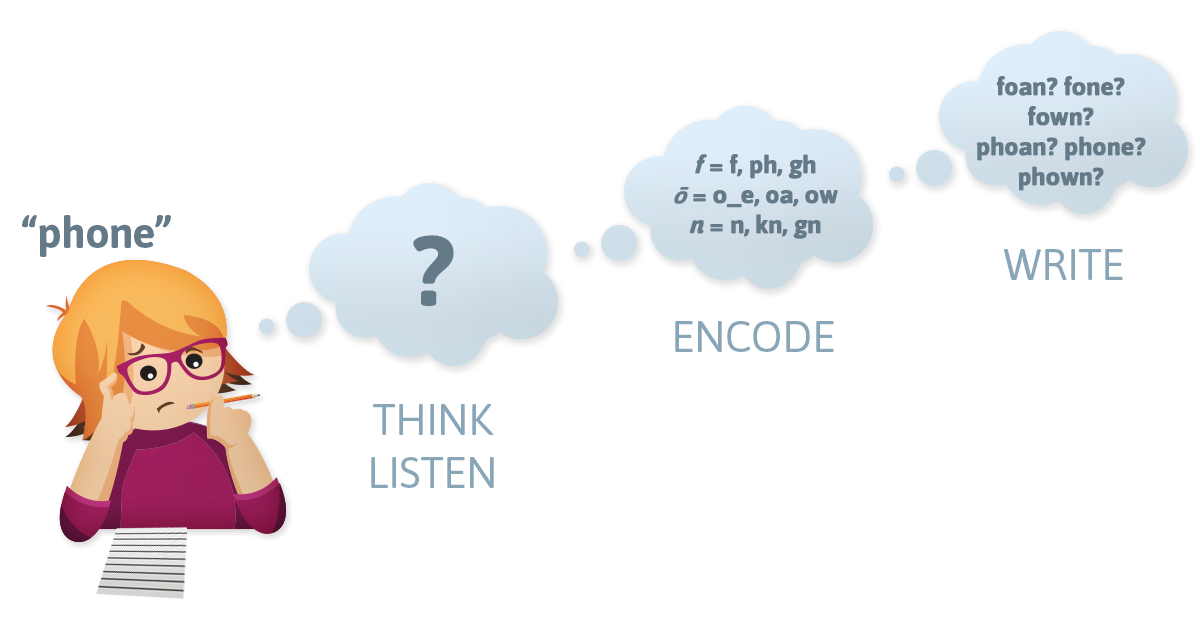
Now contrast this with the spelling process.

First the student hears the word (again, either mentally or out loud). If the spelling of the word is stored in long-term memory, it will be written correctly. If not, the brain will once again draw from known phonics rules to try to encode the word, converting sounds to letters. The difficulty here is that there is a much wider range of possible spellings. In the example given above, there may be three or four ways to read the letters p-h-o-n-e, but there are at least six ways to write the sounds in the word “phone” (assuming that it is spelled phonetically—almost half of the words in English aren’t). If the student chooses the wrong spelling, there is nothing to help him self-correct, and if the error is not addressed immediately, it is likely to make its way into long-term memory, where it will be difficult to replace.

When you compare the processes of reading and spelling, it’s easy to see why, for most students, spelling skill lags behind reading skill. This is especially true for students in the Skill Development stage (roughly third grade and above), as they are using an increasing number of words that do not follow phonics rules. Spelling You See recognizes the heavy cognitive load that learning to spell creates and deliberately lowers the reading level so that the student can concentrate just on spelling. Thus, while your student may appear to be working in a “lower” or “easier” level in Spelling You See, you will be pleased to see how, over time, the unique, research-based approach of the program will help your student spell an increasing number of words correctly. This is the way Demme Learning builds confident spellers who are able to communicate clearly and effectively.

Previous Post Next Post

Category iconSpelling You See

Weekly Newsletter

Subscribe to the weekly Demme Learning newsletter for the latest blog posts, product information, and more!

The Demme Learning Show

Join host Gretchen Roe as she facilitates fascinating conversations with a wide range of guests in the education space. Watch the show live, or watch/listen to the recorded episodes.

Learn More and Subscribe

Reader Interactions

Leave a Reply Cancel reply

Your email address will not be published. Required fields are marked *

Related Stories

  • A child writing with a parent sitting next to them.

    Spelling Slip-Ups: Common Mistakes Even Adults Make

  • A student spelling a word

    The Importance of Spelling in the Digital Age

  • Two students reading and writing

    How Are Reading Skills and Spelling Skills Linked?

Primary Sidebar

Stories
show/hide
  • A child writing with a parent sitting next to them.
    Spelling Slip-Ups: Common Mistakes Even Adults Make
  • A student spelling a word
    The Importance of Spelling in the Digital Age
  • Two students reading and writing
    How Are Reading Skills and Spelling Skills Linked?

Subscribe to our newsletter!

Thousands of parents enjoy our weekly newsletter, with informative blog posts, product information, and more!

Subscribe to The Demme Learning Show!

Join host Gretchen Roe as she facilitates fascinating conversations with a wide range of guests in the education space. Watch the show live, or watch/listen to the recorded episodes.

Learn more

Logo for The Demme Learning Show.

Footer

Our Location

Address:
Demme Learning
207 Bucky Drive
Lititz, PA 17543

Contact Us

Customer Service: M-Th 8:30am - 6pm ET
Live Chat • 888-854-6284 • Email

Hours

Monday through Thursday 8:30 am to 6:00 pm, Eastern time.

Connect with us

  • Facebook
  • Instagram
  • TikTok
  • YouTube
  • Twitter

Sign up for our newsletter

Sitemap

  • Home
  • About
    • Philosophy
    • History
    • Company Culture
    • Careers
  • Products
    • Math-U-See
    • Spelling You See
    • Analytical Grammar
    • WriteShop
    • Building Faith and Family
    • KinderTown
  • Blog
  • Guild
    • Math Resources
    • Spelling Resources
    • Webinars
    • eBook
    • Digital Toolbox
    • Partnerships
  • Events
    • The Demme Learning Show
    • Virtual Events
    • In Person Events
  • Digital Toolbox
  • Support Center

Terms & Conditions  •  Sitemap  •  Copyright © 2026 Demme Learning •  Return to top