




Picture this: Young students stare at math problems, their brows furrowed in concentration as they struggle to calculate solutions. Meanwhile, their peers are quickly writing down answers and moving easily through the material.
What’s the difference? The struggling students are just as smart and intelligent as their peers … they just aren’t seeing numbers and equations in quite the same way. Instead, their minds long for images of physical objects, spatial relationships, and diagrams. These are visual thinking kids, and their learning process differs significantly from that of their more verbal peers. In the world of mathematics, where abstract concepts are the norm, visual learners often face challenges.
But what if we could transform these challenges into opportunities?
Visual thinking is more than just a learning preference; it’s a unique way of processing information. When it comes to mathematics, visual thinkers excel at seeing patterns and relationships. By tailoring math instruction to these students, we can tap into their potential and make mathematical concepts come alive for them.
At Demme Learning, we utilize the “Build, Write, Say” method – a game-changer for teaching addition and subtraction to visual learners. This approach combines hands-on manipulation, written work, and verbal expression to create a multi-sensory learning experience. With proper preparation, thoughtful presentation, and regular practice, this method can revolutionize math education for visual thinkers.
Understanding Visual Thinking Kids
Visual thinking is a distinct learning style where students process information best through visualization and observation. Visual thinkers benefit from seeing concepts in action, unlike auditory or kinesthetic learners. They often possess a vivid imagination and can easily recall images, diagrams, and visual patterns.
Common characteristics of visual thinkers include:
- Strong spatial awareness
- Preference for charts, graphs, and diagrams
- Excellent memory for visual details
- Tendency to doodle or draw while thinking
- Strong visualization skills
Identifying these traits early is important for teachers and parents alike. By recognizing visual thinkers and applying visual thinking strategies, we can better support these students along their mathematical journey.
The Build, Write, Say Method
The Build, Write, Say method is an approach that caters specifically to visual thinkers and helps guide them toward math mastery. This method incorporates three key steps:
- Build: Use physical objects (math manipulatives) or visual aids to represent math problems.
- Write: Write out the math problems and solutions.
- Say: Verbally explain the process and the “why” behind it while building and writing.
This method is particularly effective for visual thinkers because it engages multiple senses and reinforces learning through different modalities. By physically manipulating objects, students can see the math concept come to life. Writing helps solidify the concept and saying it out loud reinforces understanding.
Teaching Addition and Subtraction to Visual Thinkers
Let’s apply the Build, Write, Say method to teach single-digit addition and subtraction:
- Build: Start with color-coded math manipulatives. For example, to teach 3 + 5:
- Use a pink 3-block to represent 3
- Place a light blue 5-block next to it to represent 5
- Show the sum by placing a brown 8-block underneath the 3 and 5 blocks
- Write: Have the student write out the problem: 3 + 5 = 8
- Say: Encourage the student to explain the process: “I have a pink 3-block. I’m adding a light blue 5-block. When I put them together, I see that it has the same length as the brown 8-block, so 3 plus 5 equals 8.”
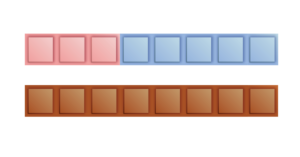
For subtraction, use a similar approach. For instance, to teach 8 – 3:
- Build: Start with a brown 8-block, then invert a pink 3-block on top of it. Place a light blue 5-block next to the inverted 3-block to show the difference.
- Write: 8 – 3 = 5
- Say: “I start with a brown 8-block. I flip the pink 3-block over to show that I’m taking away 3. The difference is shown by the light blue 5-block. So, 8 minus 3 equals 5.”
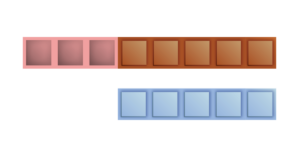
This method, using color-coded blocks, helps visual learners create mental images that act as referents, making abstract ideas concrete and easier to grasp.
What Happens Inside the Student’s Brain
When visual learners engage with math using this method, several cognitive processes come into play. The visual cortex is heavily involved in processing the images of the manipulatives and written numbers, while the parietal lobe works on spatial relationships and number sense.
The Build, Write, Say method enhances understanding and retention by creating multiple neural pathways. As students build and manipulate objects, their motor cortex is engaged. Writing activates language areas and fine motor skills. Speaking out loud involves auditory processing areas.
This multi-sensory approach strengthens connections between different parts of the brain and leads to deeper learning and better recall.
Tips for Parents and Educators
To effectively implement the Build, Write, Say method and support visual thinkers in math:
1) Use Diverse Visual Ads
Incorporate color coding, diagrams, and graphic organizers. For example, use different colors for tens and units in place value exercises.
2) Encourage Drawing
Let students draw pictures to represent problems. This can be especially helpful for word problems.
3) Utilize Technology
Many educational apps and programs offer visual representations of math concepts. Math fact fluency can be enhanced through visual games and activities.
4) Create Math Picture Books
Help students create their own books illustrating math concepts with drawings and explanations.
5) Use Real-World Examples
Connect math to visual experiences in daily life. For instance, use pizza slices to teach fractions.
6) Provide Plenty of Practice
Consistent practice is key. Offer tips for struggling math students to build confidence.
7) Incorporate Movement
Combine visual thinking with kinesthetic activities. For example, use mud math activities to make learning tangible and fun.
8) Be Patient
Allow students to process information at their own pace. Visual thinkers may need more time to “see” the problem before solving it.
Remember, every child is unique. What works for one visual learner may not work for another. Be prepared to adapt and find the methods that resonate best with each student.
The Value of Tailored Math Instruction
By understanding and catering to the needs of visual thinkers, we can transform math from a daunting subject into an engaging, even exciting, experience. The Build, Write, Say method, combined with various visual thinking strategies, opens up new pathways for comprehension and problem-solving.
As educators and parents, our role is to provide the tools and support that allow visual thinkers to thrive. By doing so, we’re not just teaching math – we’re nurturing creativity, boosting confidence, and laying the foundation for lifelong learning.
Want more math resources? Check out The Guild! This free archive provides resources for building math skills and learning math facts.



Leave a Reply