




A student can work through the same type of math problem again and again without making meaningful progress. Practice may help a developing skill, but repeated review can become frustrating when the real problem emerges several steps earlier.
For example, one student working on fractions may understand what the fraction represents, but repeatedly loses track of their place in the problem. While in another case, difficulty with place value may point to an underlying concept that is still unclear.
These situations don’t necessarily call for the same response, but addressing them requires identifying where the math actually begins to break down.
How Do You Know When a Student Needs a Math Intervention Program Instead of More Review?
A math intervention program may be a better next step when a student repeatedly struggles with the same foundational skill despite appropriate review, and that gap interferes with newer work. Instead of restarting an entire earlier level, targeted intervention identifies the missing skill, teaches it directly, checks for mastery, and helps the student return to forward progress.
A difficult lesson by itself doesn’t indicate that intervention is necessary. Students need time to practice new concepts, make mistakes, and build fluency. The concern grows when a student receives additional explanation, practice, or reteaching, but the same underlying difficulty continues to appear.
Review, Remediation, and Targeted Intervention Serve Different Purposes
The right approach depends on what’s causing the student to struggle and how broad the underlying gap appears.
Review gives a student more opportunities to practice something they generally understand. A student may grasp multiplication but need additional practice applying a new procedure accurately.
Broader remediation returns to earlier content that has not been mastered. This can be appropriate when several connected concepts are weak. Sending a student through an entire lower-level course, though, may add unnecessary repetition when the actual gap is much narrower.
Targeted intervention isolates a specific prerequisite skill and gives that skill concentrated attention before the student returns to more advanced work.
A systematic review of research on mathematics interventions found that interventions for students experiencing mathematics difficulty often concentrated on relatively narrow mathematical content. Representations, computational fluency, and explicit instruction were among the approaches commonly used.
The goal is to match the instruction to the student’s challenges rather than simply assigning more math.
Signs That Ordinary Math Review May Not Be Enough
Look for patterns that persist across several lessons rather than reacting to one difficult day.
A student may need closer investigation when they:
- Make the same type of error even after reteaching and practice.
- Rely on finger counting, tally marks, repeated addition, or other inefficient strategies for familiar facts.
- Understand a new concept but repeatedly lose their place while completing prerequisite calculations.
- Complete a skill in one familiar format but struggle to apply it in another context.
- Need so much effort for basic computations that multi-step problems become difficult to finish.
- Begin avoiding math, procrastinating, shutting down, or becoming increasingly frustrated during lessons.
A weakness in foundational math gaps does not automatically mean a student needs to repeat everything that came before it. The more useful question is which specific skill is interfering with progress.
Start by Finding the Actual Math Gap
A student who says, “I can’t do fractions,” has identified the place where frustration appears, but not necessarily where it begins. Break the task into smaller parts.
- Can the student represent the fraction accurately?
- Compare two fractions?
- Recall the multiplication facts needed to find an equivalent fraction?
- Complete the required calculation without stopping to count?
A similar process works with place value, long division, algebra, and other difficult concepts for students. Try using a simple sequence:
- Observe the recurring problem. Record what the student does when the difficulty appears.
- Work backward to prerequisite skills. Identify what the current task requires the student to understand or recall.
- Check those skills directly. Use focused questions, a short diagnostic activity, or appropriate placement tools rather than assuming the student’s grade level identifies the problem.
- Choose the narrowest appropriate support. Review may be enough. A conceptual gap may need focused instruction. A fact-mastery problem may call for a specific intervention.
- Check for mastery before moving forward. Ask the student to demonstrate the skill independently and apply it in another context.
This process keeps the response focused on what the student needs at the present time, rather than reaching back into material that may already have been successfully covered.
Pay Attention to Math Anxiety Without Treating It as a Diagnosis
Tears, avoidance, frustration, or comments like, “I’m bad at math,” deserve attention. They tell you the student’s current experience with math is becoming difficult to sustain. The reactions themselves, though, do not explain why they occur.
A meta-analysis of K-12 math anxiety interventions examined both math-skill interventions and therapeutic approaches. The findings reinforce the importance of considering both mathematical performance and the emotional response surrounding it.
A student may need stronger foundational skills, support for anxiety, or both. Start by making the next task achievable and giving the student evidence that a difficult skill can become manageable.
When Does an Accelerated Math Intervention Make Sense?
Acceleration in this context means concentrating instruction on a missing skill without requiring the student to repeat unrelated material.
When the missing skill is relatively narrow, an accelerated intervention can focus attention on the specific prerequisite that is hindering progress instead of sending a student back through material they have already mastered.
Math-U-See’s Accelerated Individualized Mastery program applies a focused approach specifically to math fact mastery. AIM provides targeted intervention for students who have already encountered arithmetic facts but have not yet developed sufficient mastery. Its interventions focus on addition and subtraction facts or multiplication facts with a bridge to division.
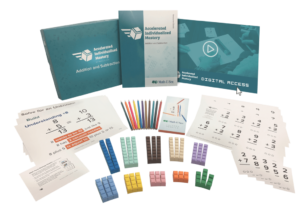
A student struggling with fractions or place value does not automatically need AIM. Those difficulties are reasons to investigate further. If inefficient fact recall is interfering with the newer skill, AIM may be an appropriate intervention. If the gap involves the fraction or place-value concept itself, the student needs instruction targeted to that concept instead.
A Math Gap Does Not Have to Become a Permanent Setback
Persistent math struggles can make students and instructors feel as though the only options are to keep pushing ahead or start over. A targeted intervention offers another path.
- Identify where progress is breaking down.
- Give that skill focused attention.
- Confirm mastery.
- Then return to forward movement.
A temporary pause can address the skill creating difficulty without requiring a student to abandon everything they have already accomplished.
If repeated review is no longer changing the pattern, watch the companion episode of The Demme Learning Show, Can an AIM Intervention Create a Better Math Experience?, for additional guidance on identifying fact-mastery difficulties and determining whether an AIM intervention could be an appropriate next step.
Frequently Asked Questions
Not necessarily. If the difficulty comes from one specific prerequisite skill, targeted instruction may address the gap without requiring the student to repeat material they have already mastered. Broader remediation may be more appropriate when several connected concepts remain weak.
In some cases, yes. If the gap is relatively narrow, targeted intervention can focus on the specific skill that is interfering with progress without requiring the student to abandon unrelated work they have already mastered. The key is making sure the missing skill receives enough focused attention to support continued progress.
Look for independent, efficient use of the targeted skill. The student should be able to demonstrate the skill without relying heavily on previous inefficient strategies and apply it to another problem or context. Continue monitoring the skill after returning to regular instruction so the improvement holds as mathematical demands increase.



Leave a Reply