



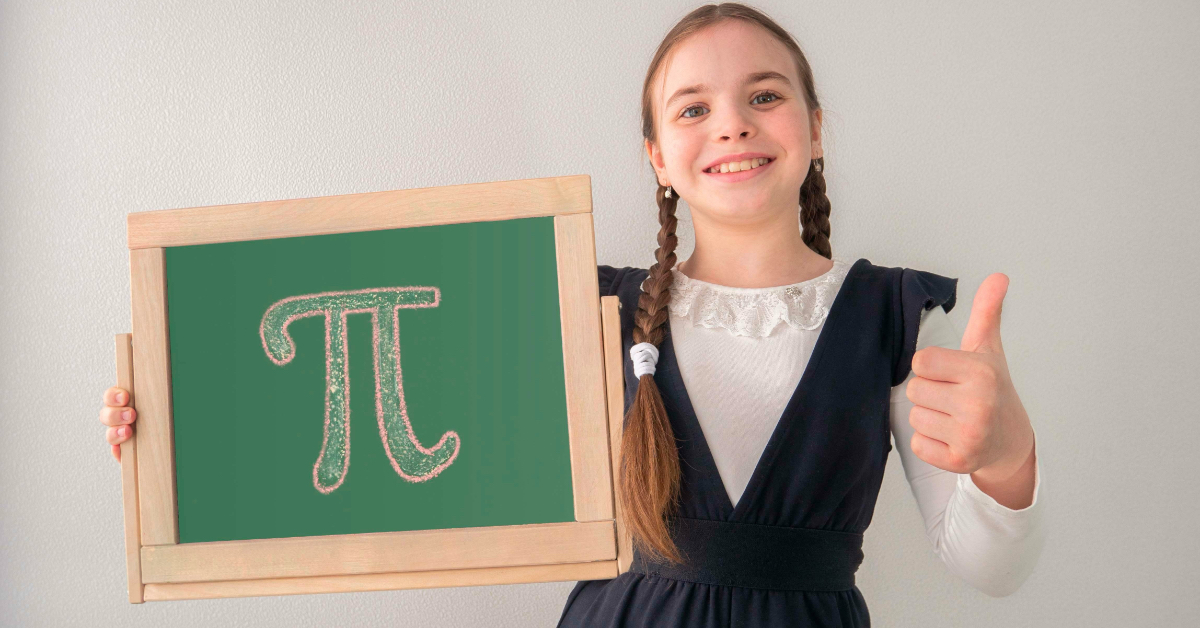
Most people recognize Pi from geometry class as a strange number that starts with 3.14 and goes on forever.
But this mathematical constant reaches far beyond the classroom into real life, playing a vital role in everything from the smartphone in your pocket to the satellites orbiting above.
While many see Pi as merely an interesting anomaly, its influence is vast. Math enthusiasts everywhere celebrate Pi’s importance thanks to physicist Larry Shaw, who, in 1988, organized March 14 (3.14) as International Pi Day.
From engineers calculating structural integrity to scientists measuring light waves, this irrational number shapes our daily lives and appears everywhere.
What is Pi?
The concept of Pi has fascinated scholars for millennia. Ancient civilizations, from Egypt to China, recognized this special ratio and often approximated it. Today, computer science allows us to calculate Pi with unprecedented accuracy, enabling everything from precise engineering to complex space exploration.
At its core, Pi represents the ratio of a circle’s circumference to its diameter. This mathematical constant, represented by the Greek letter π, cannot be expressed as a simple fraction, making it an irrational number.
Although the first few digits often serve as its main representation, Pi continues infinitely without repeating patterns. Mathematicians have calculated trillions of digits, though most practical applications require far fewer.
Pi in Nature
Nature itself seems to recognize Pi’s significance.
The constant Pi emerges in many natural phenomena, from the way light waves ripple through water droplets to create rainbows to the spiral formation of galaxies in space. The number manifests in the circular patterns of ripples when a raindrop hits a calm pond, and it appears in the mathematical description of natural vortices, from tiny whirlpools to massive atmospheric systems.
Even the growth patterns of certain plants reveal Pi’s influence in the arrangement of their leaves around a stem, maximizing exposure to sunlight.
When engineers and scientists study waves—whether in water, sound, or light—Pi proves essential to understanding their behavior. This relationship helps determine everything from acoustic design in concert halls to signal processing in Wi-Fi networks. Even the way light waves propagate through space follows patterns governed by Pi.
Pi in Engineering and Technology
Pi underpins critical engineering calculations that shape modern technology.
Engineers use Pi when designing precision instruments like accelerometers and gyroscopes that require exact circular measurements. In fluid dynamics, Pi helps calculate how liquids and gases flow through pipes and around obstacles, enabling everything from efficient fuel systems to wind tunnel testing.
One example of Pi’s importance is in the design of digital technology. Engineers working on electronic devices use trigonometry and Pi to determine signal processing parameters. From smaller-scale circuits to massive telecommunications systems, Pi helps create the digital world. Even the design of computer processors involves Pi in calculations related to clock speeds and signal timing.
Modern manufacturing also heavily relies on Pi. Engineers use Pi to design circular components, calculate fluid dynamics in pipes, and determine the specifications for rotating machinery. This applies to everything from industrial robots to household appliances.
Pi in Architecture and Construction
Architects and construction engineers frequently use Pi when designing curved structures. The circumference of a circle or circular structure can’t be expressed as a simple fraction of its diameter – that’s where Pi comes in. Whether calculating the materials needed for a dome or determining the load distribution in an arch, Pi proves indispensable.
From ancient mathematicians who used Pi to build the pyramids to modern engineers designing skyscrapers, this value has shaped our built environment. The challenge of achieving the necessary accuracy in these calculations has driven both mathematical innovation and engineering precision. Modern architects rely on Pi when designing geometric facades and energy-efficient curved surfaces that optimize natural lighting and airflow.
Pi in Sports and Physical Activities
Even athletics involves Pi. Sports equipment designers use Pi to calculate the optimal curvature of a basketball or the aerodynamics of a tennis racket. The circumference of any ball, from soccer to baseball, is specified using Pi.
Training facilities use computer models incorporating Pi to analyze athletic performance. Whether determining the perfect trajectory for a shot or designing the ideal curve of a racetrack, Pi helps athletes and coaches optimize performance. Swimming pool designers use Pi to calculate volume and water flow, while track designers use it to determine optimal curve radii for peak running speeds.
Pi in Astronomy and Space Exploration
Space research relies heavily on Pi. Scientists and engineers use Pi to calculate the volume of a sphere when studying planets, while orbital mechanics depends on Pi to determine spacecraft trajectories. The number theory behind Pi even helps calculate the positions of celestial bodies.
As we venture further into space, the accuracy of our calculations becomes increasingly critical. Pi’s infinite digits provide the precision needed for these complex determinations. Mathematicians continue to calculate more digits of Pi, though most space applications require only a relatively small number of them. NASA engineers routinely use Pi to calculate everything from rocket design to planetary exploration.
Making Pi Work for You
In our modern world, Pi’s influence extends far beyond geometry class. Whether you’re using your smartphone’s GPS, watching a satellite TV signal, or simply admiring a curved building, you’re experiencing Pi at work. As we celebrate Pi Day each March, we recognize not just a mathematical curiosity but a fundamental constant that helps determine how our world functions.
From the most sophisticated research facilities to everyday technology, Pi continues to prove its value. The next time you see a circle, remember that this simple shape connects us to one of mathematics’ most powerful tools—one that engineers, scientists, and mathematicians use to shape our world every day.
Follow us on Facebook or Instagram for more math application ideas!



Leave a Reply