



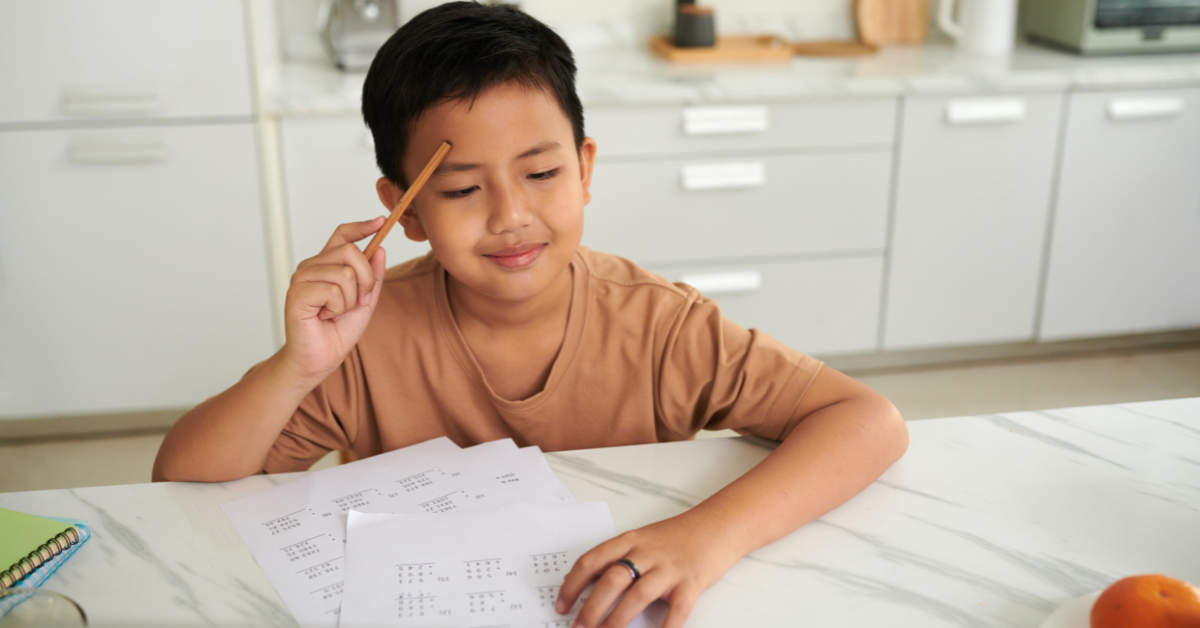
An equation like 24 ÷ 6 doesn’t mean much to the average student … until it is applied to a meaningful situation.
For example, when six students must divide 24 chicken tenders equally, the numbers suddenly have an important purpose. Students can picture the task, recognize the relationship, and see why division provides the solution.
Why Storytelling Helps Students Understand Math
Storytelling can help students understand math by giving numbers, operations, and solutions a meaningful context. Students who can visualize a problem can build a mental model, choose an operation, and explain what the answer means.
Narrative places quantities and operations inside a sequence that students can follow. Students can identify what happens first, what changes, what remains, and what must be determined. The equation then represents a situation rather than a disconnected set of symbols.
This type of narrative-based learning does not require an elaborate plot. A few focused sentences may be enough to answer three key questions:
- What is happening?
- How are the quantities related?
- What needs to be found?
The process also fits Demme Learning’s mastery-based approach. Students first make sense of the relationship, then represent it with numbers and symbols. Manipulatives can make quantities visible before calculation begins, while verbal explanation gives instructors another way to check understanding.
How Narrative Supports Word-Problem Reasoning
Word problems require more than computation. Students must interpret language, identify relevant information, represent the situation, choose an operation, calculate, and decide whether the result makes sense.
This process shows the literacy and numeracy connection within math instruction. Students need mathematical knowledge, along with vocabulary, sequence, and context.
Before students begin to calculate, ask them to retell the situation:
- Who or what is involved?
- What changes?
- Which quantities matter?
- What remains unresolved?
Sketches, diagrams, or a set of manipulatives can help students visualize the relationships in a word problem. These representations also make a student’s thinking visible, so instructors can see whether the underlying relationship makes sense.
Should Students Look for Keywords or Start with the Story?
Most students approach a word problem in one of two ways. The difference shows up in whether they can explain their answer or only produce it.
| Operation-first reasoning | Story-first reasoning | |
| Starts with | Numbers and keywords | The action and the goal |
| Student asks | “Which words tell me what to do?” | “What is happening, and what needs to be found?” |
| Example | “Altogether” signals adding; “left” signals subtracting | Six students must share 24 chicken tenders equally, so the situation calls for equal groups |
| Breaks down when | The same keyword appears in problems needing different operations | Rarely, if the story stays focused on the relationship |
| Student can explain why? | Often no | Yes |
Keywords can provide clues, but they cannot explain a relationship. Story-first reasoning gives the student a reason to choose an operation and a way to check whether the answer makes sense.
What to Do When Calculation Is Easy but Word Problems Are Hard
When a student can complete an equation but struggles with word problems, ask them to retell, draw, or build the situation before selecting an operation. This separates the calculation from the language demands and helps reveal whether the difficulty involves vocabulary, sequence, identifying relationships, or applying a familiar procedure in context.
Start by covering the numbers in the problem. Ask the student to explain what is happening without calculating. Then uncover the quantities and use objects, blocks, or a sketch to represent the action.
This process gives instructors more useful information than another round of computation practice. A student who can calculate 24 ÷ 6 may need support interpreting equal sharing rather than spending more time with division-fact practice.
How to Turn a Math Problem Into a Story
Instructors can add narrative without creating a heavy reading burden.
- Assign a role. Make the student or character a planner, builder, investigator, shopkeeper, scientist, or navigator.
- Establish one goal. The character may need to divide supplies, compare prices, complete a design, or find a missing quantity.
- Include only necessary details. Remove names, descriptions, or events that do not affect the solution.
- Identify the question. Ask the student to state what must be determined before calculating.
- Solve and interpret. Return to the situation and ask what the answer represents.
For example, 7 × 4 = 28 can become a garden problem with seven rows of four seedlings. Students must determine how many seedlings are growing in all.
A mystery version might ask students to find a missing side length when they know a rectangle’s perimeter and three side measurements. The missing measurement creates a clear question without adding unrelated details.
Keep the Plot Focused on the Mathematics
A narrative helps when it makes a relationship easier to picture. It can interfere when students must remember several characters, follow an unrelated subplot, or sort through facts that do not affect the answer.
Use one role, one objective, and one clear complication whenever possible. A short mission often works better than a detailed adventure.
Physical movement can also help students represent a problem, especially in early grades. In a classroom, students might arrange themselves into equal groups before writing a division equation. At home, a student could divide snacks, blocks, or craft supplies among family members.
Manipulatives keep attention on quantities and relationships. Math-U-See Integer Blocks, household objects, or a quick drawing can provide a concrete model of what happens in the story.
Find Math Stories in Daily Life and Literature
Math Stories in Everyday Routines
Homes and classrooms already contain quantities, limits, comparisons, and decisions. Instructors can turn those moments into brief, math-focused stories:
- Adjust a recipe to serve more or fewer people.
- Plan when a family or class must leave to arrive on time.
- Compare purchases within a fixed budget.
- Divide supplies equally among small groups.
- Track points, averages, or probability during a game.
A classroom instructor might give several groups the same equation and ask each group to create a different setting. Students can compare their stories and identify the shared mathematical relationship.
Homeschool instructors could turn meal planning into a budgeting problem or ask students to calculate how much paint a household project requires.
Demme Learning’s guide to using math during national park visits shows how distance, pace, elevation, budgeting, and wildlife observations can become purposeful mathematical questions.
Using Literature to Support Math
Using literature to teach math can extend this approach into reading time. Picture books, novels, biographies, and informational texts often contain patterns, measurements, money, time, distance, or data.
Pause when a mathematical question appears naturally. Students might estimate how far a character traveled, compare the sizes of two objects, calculate elapsed time, or decide how to divide supplies fairly.
The book provides the setting and characters. The instructor adds a focused question that directs attention toward the mathematical relationship. Direct math instruction sets foundations, while literature provides a useful setting for application and review.
For more on math anxiety and the mathematics inside cooking, music, planning, and everyday problem-solving, watch Transform Math Stress into Success with Vanessa Vakharia on The Demme Learning Show.
Use Build, Write, Say to Represent the Story
Demme Learning’s Build, Write, Say method gives instructors a practical sequence for connecting a narrative with mathematical symbols and spoken reasoning.
- Build the situation with manipulatives, objects, or a drawing.
- Write the equation that represents the action.
- Say what happened and explain what the answer means.
Building shows how the quantities relate, writing connects the model with notation, and verbal explanation reveals whether the student understands the concept or has followed a procedure without context.
This sequence supports mastery-based instruction because students must model the relationship, justify the operation, and apply the concept within a new setting before moving ahead.
Give Every Procedure a Purpose
A mathematical procedure may be easier to remember when students understand why it belongs in the problem. Narrative gives the procedure a purpose. An operation becomes a decision, and the answer resolves a meaningful question.
Start with one equation. Give it a setting, a goal, and a clear mathematical relationship. Then ask your students to explain how the story ends.
Looking for more support for your math instruction? Watch Practical Tips for How to Teach Word Problems for additional guidance on manipulatives, active participation, and student explanation!
Frequently Asked Questions
Persistent difficulty across levels usually points to a gap in foundational understanding rather than reading comprehension. A placement test can show where the concepts stopped connecting, so instruction can restart at the level where a student is ready to build.
Yes. Older students can use realistic situations involving rates, budgeting, geometry, probability, and data. Match the narrative to the concept and the student’s level of mathematical maturity.
No. Recipes, schedules, purchases, sports, travel plans, and building projects already contain quantities, limitations, and decisions.
Yes. A book can provide a setting or problem that gives a mathematical question context. Instructors should still teach the concept directly and use the story for application or review.



Leave a Reply