



Imagine transforming a family vacation into an enriching worldschooling adventure. Enjoy this conversation with Sara Dawson, who, along with her husband, Sam, took their daughters to Brazil for a month in the spring of 2025.
Discover how they navigated a new environment, including attending a Brazilian private school, exploring the seaside and the mountains, and immersing themselves in Brazilian culture. Our chat with Sara will also feature a special Q&A with her daughters, Emma and Kenzi, who will offer their unique perspectives on this once-in-a-lifetime experience.
Episode Transcript
[00:00:00] Sara Dawson: If you are a parent of children and you’re trying to watch this video to gauge if this is something you’d want to do, I would encourage them to just know that this is the time to be hands-on with your children right now.
[music]
[00:00:22] Gretchen Roe: Good afternoon, everyone. This is Gretchen Roe for The Demme Learning Show. I am so excited to welcome the Dawson family today to talk to you all about a little bit of world schooling. They had the privilege to visit Brazil this spring. It was such an amazing experience. I got the privilege to meet them at a homeschool conference just before they were going to start. I was so excited.
Before they even left, I said, “Would you guys come on this show and talk to me about your experiences,” because I think this is going to be a really particularly special conversation. I’m very privileged to have their daughters with us too because they got to experience the joy of this. Thank you all for welcoming us into your living room. Sara, I’m going to let you take it away and introduce yourselves.
[00:01:11] Sara: First, I want to say thank you for having our family. We’re privileged to be able to sit here and talk with you today. We are very happy that we had this experience and we look forward to many more. This is Kenzi right here and this is Emma. As you mentioned, I am Sara Dawson and we are a homeschool family. We are on our third year and we also do construction.
Our girls have been with us through the whole process with work. They’re always constantly with us. When they were infants, we had them with the little pack and play on the job site. We’ve always been big into hands-on and learning everything from a real-life perspective, not just out of a textbook, which it was natural. When we were invited to go to Brazil and we had the opportunity to be able to go to a private school, we jumped all over it.
[00:02:11] Gretchen: I think that’s pretty cool. Sometimes as parents, we’re hesitant to do those kinds of new experiences with our children because we don’t know what it’s going to be like. You guys were really brave to do this without having all of the answers, just to trust and go forward. Tell me a little bit about that. How did you all first conceive of this idea of, yes, we can go to Brazil, it’ll be all right?
[00:02:40] Sara: First, to set the ground, we are really big on exploring. We try to go hiking at least once a week with the girls. It’s our mental reset. We get away from anything. We leave the phones aside and we venture out. We try to go within three hours of where we live. We go to any type of museum or any other places that they offer. If you just do some research and dig around, there’s a lot of opportunities for homeschooling families where they do homeschooling days. We just jump all over any opportunity that we are able to get.
We’re always hands-on and exploring. My husband and I, we went to Europe a few years back. The girls were with their grandparents. We backpacked for three weeks through seven countries. We really enjoyed the experience. We said we would really like the girls to be able to experience the way that we’re experiencing other cultures. We think it’s important to know that there’s more than just beyond the way our culture is. It’s also important to know that not everyone has the different privileges that we have in America. I think it helps us to be better citizens and understand and appreciate what different politicians tend to try to fight for, that we try to fight for our freedom. You really can’t grasp it unless you see the other side.
[00:04:12] Gretchen: Very true.
[00:04:13] Sara: You can read things, you can watch things, but until you actually experience it hands-on, it’s a whole new viewpoint. We have a friend that lives in Brazil. He’s been inviting us to go for over 10 years. We’ve always put it off. We finally said to him in December that we were going to make the jump and go. He has three children as well. We said that we would go ahead and we would visit him. While we were doing our planning stages, we talked about how his kids go to a private school there.
We talked about that the kids were homeschooled and we’d love the opportunity for them to see how kids learn there. We started coordinating and asking permission with the private school if we could enroll the girls for a week while we were there. We went for a little over four weeks and we enrolled them for a week of our stay there, so we could spend the other time doing other explorations. We were really pleased when they agreed and we went through the process to enroll them. That started getting the wheels turning to do our visit that we did.
[00:05:31] Gretchen: You know what surprised me more than anything else is that you found another country that was so willing to embrace your daughters and welcome them into a different environment for a week. Where in America would we do that? Maybe, but maybe not. I don’t know.
[00:05:51] Sara: There’s like two sides of it. One side is the more you travel, the more you see that we’re all the same. If we could all just sit down at the table and share a meal, I think the world would be a better place. We all love each other and we all want to invite and embrace each other, but there are some regulations set up that make certain things harder. I do think that– now, we didn’t enter into a public school. Public schools, even in America, would be hard because to get into temporary for a week here would not happen.
When it’s private, you pay to enter. Here in America, I think if someone were to do some digging around, they’d be surprised that more people would probably be more welcoming than you would expect. We did need to submit and make sure that we have proper documentation. We did have to submit the passports and we did need to submit the vaccination record. We did need to submit things prior to even arriving into Brazil for them to be accepted into the school. I go back and forth. I feel like we have a lot more regulation here than they do in Brazil, but I think people would be surprised how welcoming other places are.
[00:07:14] Gretchen: When we were talking getting ready to start today, I found that growing up, my husband and I lived overseas for four and a half years. We spent every dollar we made because we visited 11 different foreign countries while we were there. I wouldn’t have traded that for anything. We wanted to be in and amongst the regular folks. We would wander around until we found a little hole-in-the-wall restaurant, and then we would wander in.
That was how we got to learn about different cultures and communities, and it was amazing. I think you all did a little bit of that. You told me when we first talked about this some stories. Will you share some of those experiences, especially the one about the family you fell in love with so much?
[00:08:04] Sara: Yes. We joke that’s our new grandma and grandpa. We didn’t go to your typical tourist places. We feel that if you really want to embrace the true culture and experience, you’ve got to step away from the façade that some of the places will put on. If you really, truly want to have the true experience and a more affordable experience, you need to do further research on where to go. You’d be surprised you can actually go further with your funds on the options of what to do if you just step away from where the tourism is.
We took a boat through the jungle, and the girls were able to jump off of the roof of the boat. We had the guy that led the boat, he did a Brazilian barbecue on the boat for us. That was a really cool experience driving through the jungle in the boat, just guiding through. Then we also did a private tour with a guide. He spoke no English, so it was a little bit tough, but we did have a friend there that was able to help us with translating. We went through the rainforest, and he took us to a special part where led us to a big open beach.
That area was an area that up until a handful of years ago, you couldn’t step grounds unless you were there to do different studies. It was an area that they did different studies, and they finally opened it up to the public. That was really special. We stayed with our friend for a period of the time. When we stayed with our friend there, they have some live-in servants because the lifestyle there is a lot of people use servants there, which would be more costly and more difficult to do in America, but they have the servants there. The girls learned different types of cooking and we learned how they wash their clothes and how they don’t really have dishwashers and they don’t have dryers and the way you’re supposed to hang things. They taught us how we purchase groceries and they don’t have the sanitary that we have, unfortunately. We learned how you go to the markets and you purchase your fruits and you need to soak them for two hours so that you can make sure that everything has come out of them and that there’s not any pests in them. Then once they’re soaked, then you rinse them and then you can leave them out to dry before you eat them.
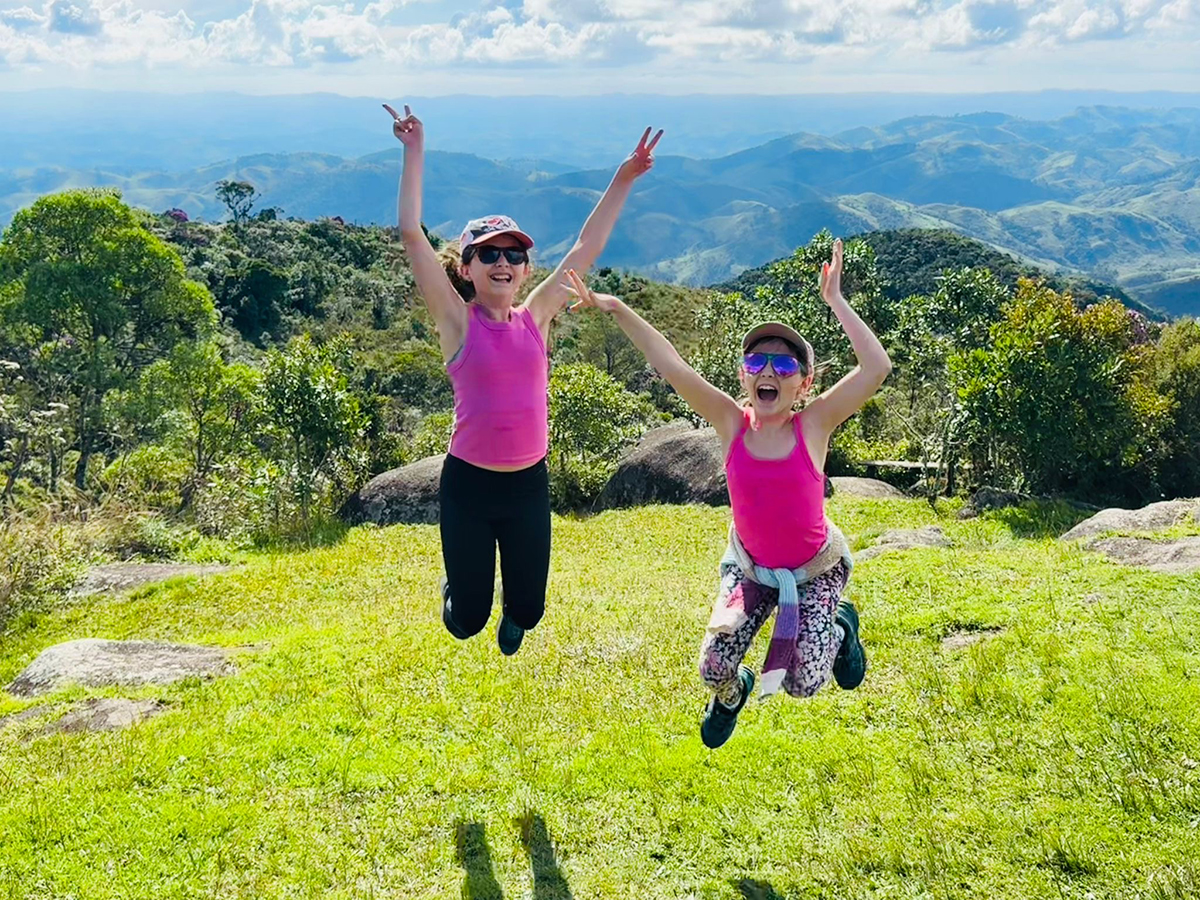
How you purchase the meats in the meat markets. We just learned a lot of the different hands-on things with that. When we ventured away from our friend, we started doing some exploring and we found ourselves immersed in a place called and it’s in the mountains a Cunha it was the most magical part of our trip. We did some research while we were driving through, fell in love with it, never intended to stay there. We thought, “Oh, let’s not go visit the mountains.”
We live in the mountains and we just fell in love with it driving through. We pulled over, did some research and we said we should stay here. We looked at some reviews and we found a place that had four cottages and we called them and asked if they had a room for three nights and they said they did and we got there and we didn’t realize that it would be cold in the mountains. We thought, oh, Brazil, everything’s warm.
[00:11:43] Gretchen: Oh, goodness.
[00:11:45] Sara: We only had packed with us some warm clothing.
[00:11:50] Gretchen: Sure, because you were there in the middle of summer.
[00:11:53] Sara: Yes, we thought, “Oh, everything’s great. We don’t need to bring anything warm.” We didn’t even have jackets. We showed up and he looked at us and he says, “Aren’t you guys cold?” At first, we were confused because he was speaking English to us and almost everybody there doesn’t speak English. Turns out, he had worked with an American company. He was retired and opened these little chalets, they call them.
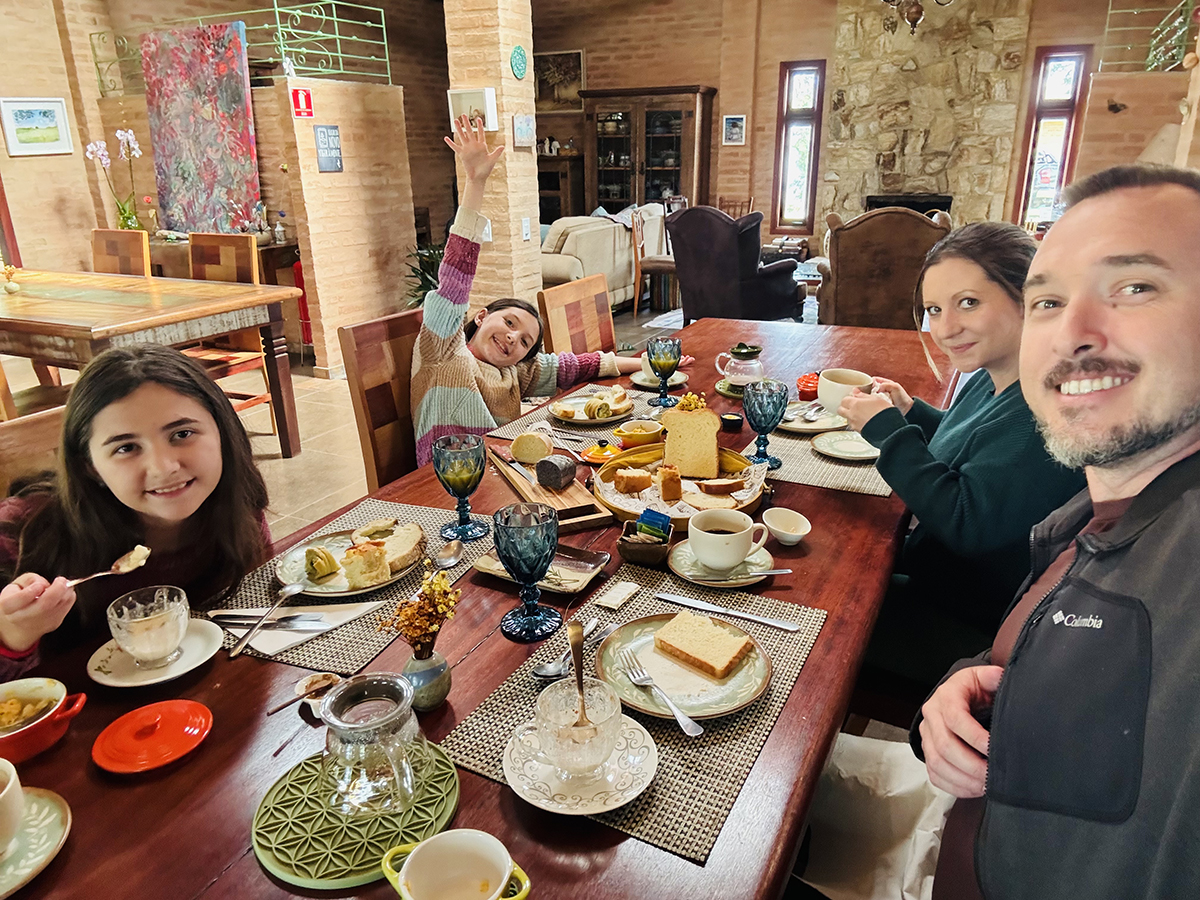
He, luckily for us, was bilingual and he says, “Let me go get some clothing for you,” was how it started, which was an amazing welcome and we were very cold. He found a suitcase with a couple of things. Nothing fit us, but we put on these clothes and he says, “It’s late now. Why don’t you guys come into our little clubhouse area,” and started feeding us all these foods. The foods were so good and we thought, “Well, wow, where did these foods come from?” He says, “Oh, my wife bakes and makes all of this.” We thought, “Wow, this is amazing. We need to meet her.”
We go into the kitchen and that was the end. The girls met her and she started hugging them and she says, “Come back tomorrow and I’ll teach you how to bake and cook.” The girls ended up cooking with her and learning how to do the measurements and learning how to bake and everything was from scratch. Everything was from the local farm, either that they had on their grounds or from another local farmer. They said, “What are you going to do while you’re staying in Cunha? Because it’s a small little country town, there’s not a whole lot to do.”
We said, “We don’t know, but we just fell in love.” He says, “Well, I’ll take you and teach you. Have you girls been on horseback?” They said, “No.” He took them and taught them how to go on horseback and took them through the fields to ride horses. He says, “I want to teach you our grounds,” and took us on a trail and showed us all the different trees and showed us the gardens and was teaching us about all the little local fruits. Every single morning we woke up and the entire table was covered with gourmet food.
We ended up doing two trips for three days each to them while we were there. We fell in love. We went back a second time. We counted and she baked 26 different goods for us during those six days, all from scratch. She would stay up all night long baking. One of the nights that we were there, they said, “Well, where are you going to go for dinner tonight?” The girl said, “We want to eat with you guys.” They said, well, they were a little taken back because they don’t normally have the guests that want to spend time with them.
They said, “Well, where do you want to eat?” The girl said, “We want to cook with you.” They said, “Oh,” and they weren’t expecting that. We ended up gathering together. The girl said they wanted to teach her how to make gnocchi. She said, “Oh, you could teach me.” Wink, wink. She got together and they put on this gourmet meal. My husband and I or Sam, we weren’t allowed in the kitchen. They said we need to go and walk the grounds and enjoy ourselves and have a glass of wine.
We walked the grounds and we came back and they had the table set up. The girls with this lady, her name is Fatima, they set up the table with everything that they made from scratch. We had the bottle of wine there and we had all the different local foods and the fruits and all the bake goods that she made. We sat there with these two hosts and she only spoke part English from her husband teaching her, but not much.
Even with language barriers, we just sat and embraced the moment and laughed and enjoyed and went out and stared at the sky. It was beautiful and just really soaked in. The entire experience of them having us welcome into their home, essentially, and nurturing us the way that they did. It was really special.
[00:16:19] Gretchen: Sara, one of the things as a mom that comes to mind, my kids will eat anything. They were raised on a variety of different foods and they don’t have cheap food tastes. I’ll put it that way. How do you, as a mom, teach your girls to be willing to try different things? I know friends who have children who would no more go to another country and want to eat anywhere but McDonald’s, even in a foreign country. How did you encourage the girls to do this, to be brave?
[00:16:57] Sara: To keep it short and to maybe give some encouragement to some other parents and families that are not as willing to try other foods. When my girls were really little, one would want to eat chicken nuggets, the other one would want to eat mac and cheese, and they wouldn’t want to eat anything else. They were probably three and four or four and five, somewhere along those lines. I would make food for each of them. They’d sit at their little kid table and then I’d make a full meal for my husband and I.
I came home one day and I said, “I’m not a shortened cook anymore. We’re all going to eat what I cook.” They all just looked at me like, what? What’s going on? I said, “Today’s the day.” I would make one thing for our whole family and I would put it in dishes in the center. We’d all sit at the adult table now and I would let them serve themselves rather than serving them so that they’re serving themselves. I didn’t care if they wanted to eat it. The rule was you have to try it.
They say statistically that after you try something about 10 times, your taste buds start to remember it and you start to like it. If you don’t like it the first time, you should really continue to give it a try is the long thing to remember with that. The first couple months, I remember they would throw their fits. They’d get upset and they’d maybe eat more of one thing than the other. Then as they would continue to try and try and try, they began to like. I brought them into the kitchen and I said, “You’re going to help me to cook.”
You’d be surprised that when they go through all the hard work of cooking something and they put that effort in, if they want to eat what they put their hard work into, they want to be able to try it. I would have them involved. To this day, the girls have once a week, unless we’re extremely busy, the girls cook dinner for us. I will go and assist if they need help with certain things or if they can’t remember something or if they need help with opening or cutting something. They will pick out what the meal is when we’re making our grocery list. They will talk amongst themselves and they will decide between each other.
Then they will have to learn to work together as a team and prepare a meal for us. We do that every single week. As we go out and adventure on and we do our different hikings and different things like that, we make sure that every time we go somewhere, we try different things. We eat a lot of different game meats in our house. We eat elk. Last night, we ate ostrich. We eat venison. We eat deer. We try to eat a plethora of different things just to have all of them in our taste buds. Now, the girls will try anything.
They may not like it, but they are willing to try. I also think not just in the relation to food, but you have to be willing to try something. That’s anything in life because if you don’t try, you won’t get anywhere. You have to be okay to fail because if you don’t fail, then you won’t know what it’s like when you actually succeed, and you need to be able to have the ups and downs. You can’t live in fear. You won’t succeed if you live in fear. That naturally helped us with the girls being willing to try anything that was put in front of their face when we were there. Although we didn’t like–
[00:20:22] Gretchen: I will tell you, as a parent who has raised six kids, all of whom were taught to cook beside me, your big birthday present when you turned four was you got to come to the kitchen and learn to scramble your own eggs. All six of my kids cook and cook well. As an adult now with adult children, that comes back to bless you, and it really does make a tremendous amount of difference. I’m really proud of you for doing that. I’m proud of you girls for being willing to step up and do those kinds of things. Ladies, answer for me. Now I’m curious. This is going to come back around to the Brazil trip in a different way. What’s your favorite thing to eat? Kenzi?
[00:21:10] Kenzi Dawson: I don’t really know, but I do really like to eat things like gnocchi a lot. I really love that. I like also making my own pasta, and I make my own gnocchi as well. I like to eat whatever my mom puts in front of me, so I can’t choose except gnocchi.
[00:21:31] Gretchen: There you go. That’s good. How about you, Emma? What is your favorite?
[00:21:36] Emma Dawson: Personally, I think Alfredo would be my favorite. Still, my mac and cheese is my favorite. Sorry. I don’t know. It’s hard to say. Some things I like and other things I don’t. It’s more of maybe Alfredo would be one of my favorites.
[00:21:54] Sara: She loves it.
[00:21:55] Gretchen: Ladies, what was the favorite food that you tried in Brazil?
[00:22:00] Kenzi: I really did like their sushi, but I don’t usually like it.
[00:22:04] Sara: What did you like? What was your favorite?
[00:22:07] Kenzi: I don’t know. I’m usually not a sushi fan, and this was the very first one of my second time that I had good sushi, so I’d just say sushi.
[00:22:15] Gretchen: Oh, really? All right. That’s pretty brave. I think that’s pretty awesome.
[00:22:22] Sara: Did you like the acai?
[00:22:23] Emma: Oh, the acai is really good.
[00:22:25] Kenzi: We loved it.
[00:22:26] Sara: They have these little stands on the side of the road. Here, I think a lot of us call it acai bowls. It’s called acai. They have all the different local fruits on top. It’s just like a giant fruit bowl, essentially. It’s just creamed in the bottom, and it has a ton of fruit. They have a lot of those on the side of the road.
[00:22:54] Gretchen: Well, I’m really proud of your mom for teaching you all to cook because that’s a life skill that goes well beyond just being home educated. It’s a skill you’ll take into adulthood. My youngest daughter is a semi-professional wedding cake maker now because she learned to cook alongside me. The irony of it is, unless it’s sourdough bread, I don’t like to bake, but boy, can she bake. That was something that she found that was a hobby that started as a teenager, and it’s followed her into adulthood. I think that’s really important. Ladies, I have a couple more questions for you. I want you to think about this one for a second. What was the best part of this big adventure that you all had with your parents?
[00:23:43] Kenzi: I have it already.
[00:23:44] Sara: What is it?
[00:23:47] Gretchen: Say again.
[00:23:48] Kenzi: Cunha.
[00:23:49] Gretchen: Cunha? What’s the best part?
[00:23:50] Sara: Was there a particular moment?
[00:23:54] Kenzi: Looking at the stars at night and then cooking with her.
[00:23:57] Sara: Cooking with her.
[00:23:58] Gretchen: Cooking with her. How terrific is that? If you all have any pictures that we could share in the show notes, that would be just amazing. How about you, Emma? What was the best part for you?
[00:24:09] Emma: It was actually, Cunha too, but just to say it’s been a while since I’ve seen Mercedes, my friend. We had fun together in the pool sometimes, or also Cunha. I think also cooking with her was fabulous, actually. I think his name is Marcelo. Marcelo’s food was delicious.
[00:24:28] Sara: Marcelo, I should tell you the story with him. It’s amazing. One of the other nights, our grandma and grandpa said, “Where are you going to go for dinner?” We said, “Oh, we don’t know,” because there’s not a lot of places to go. The places that you do eat are like people’s homes there in the mountains. They said, “Oh, I have the place for you. Let me see if he’s open tonight.” He wasn’t open. He says, “Let me see if he’d be willing to cook a meal for you guys.”
We had stopped there for lunch on our way in on the first time. He had met us because we were not properly dressed. It was our way in when we first were arriving into town. We didn’t speak their language. We couldn’t find anyone that spoke English in the restaurant. We were very memorable. It’s funny because some of the people said it was the first time they were meeting Americans. We weren’t easy to forget. He called him and told us about our family and said, “Would you be willing to prepare a meal for them?”
He got back to us and he says, “I have wonderful news. They’re going to prepare a private meal for you guys. Arrive at six o’clock.” We get there at 6:00. The restaurant is set beautiful, the lighting and the mood. We sit at the table and they translated in English the menu. It said at the top, Dawson’s Family Dinner. It had all the different courses of what they were making translated in English. His son was our server. The chef, which is a Michelin chef, did all the cooking by himself. We were there for three or four hours because he did everything from scratch, everything himself.
Every time he’d come out and serve it, he’d stand there and watch us all take a bite. Every time we’d ooh and ah because everything was the best food we ever had in our life. Every time we’d say something because we couldn’t speak their language and they couldn’t speak ours. Every time he saw us going, how good it was, he would just start dancing. He was all so happy. Then we drank wine and then we had a glass of wine with them. We all just laughed and hugged. It was the best night, the best meal ever. Then we all walked outside.
Of course, with the language barrier and all, we were all just so happy, so full. We all just started hugging each other. Of course, there’s no light pollution there. It’s in the mountains. We all stood up at the stars and we were all just looking at the stars. It was just a really special moment that we were treated like this. We’ve stayed in touch with our hosts, Alberto and Fatima. They still call us to this day and we do video calls.
One day, he called us and he was at the restaurant with the chef. The chef’s in the background and the girls had wrote in their book. We took a bunch of pictures together. He can’t speak our language, but he’s holding the book up and he’s pointing, this is the girl’s letter. It was just a really special moment that I don’t think we’ll ever experience again, a private meal like that. It was really special.
[00:27:44] Gretchen: You know what I think is really special here? I think this is an important takeaway for folks who will watch this video is that language doesn’t need to be a barrier. Sometimes we make the misapprehension that if we can’t speak the language, we can’t enter into fellowship. That’s not really true at all. I think that’s really important. Now, you did tell me when we talked in preparation for this, you told me a story about being very careful to be out in public, not to have your phones out. Of course, when we met in March, my first thought was, oh, yes, I could go to Brazil. I don’t speak Portuguese, but my phone, my Google Translate could do that for me. You can’t do that. Can you explain for our audience why that’s not a good idea?
[00:28:34] Sara: It’s very, very poor. It’s a third world country. That was the other side of it that I wanted the girls to see. I wanted them to know this is why we work really hard. This is why mommy tries to teach you that even though I’m a working mom, even though I work multiple jobs and I wear multiple hats, it’s at the end of the day, so that we could work hard to live in America and live the way we do. That if you don’t work hard, you can end up like the people that we passed. They have things called favelas there, which are basically little shacks all over. It’s very poor.
The short story of the favelas is years and years and years ago, Brazil went to war. When they went to war, they promised that all the fighters that were fighting, that they would be able to come back and they would provide housing for them. They fought to defend their country, came back when the war was over, and they didn’t have housing for them. They had no money, nowhere to go. They started grabbing anything and everything that they could to build these favelas so they don’t have running water, they don’t have electricity.
Over in Brazil, concrete is cheaper than any other building material, which is not the case in America. Everything is basically built out of strong concrete. All over, when you drive through, you see these favelas. The way that it’s set up in true Brazil, not a tourist area, is the outside of any building or any home or their private school is got big cement block walls and everything looks like a shack and everything looks like it’s run down, it’s dangerous, but you don’t know if it’s just like the “hood” dangerous area behind it or if it’s like a really rich person behind it because you can’t tell from the outside. Because of that, you can’t just pull over to the side of the road if you need to use the restroom, pull over to eat.
Luckily, we have a friend that lives in Brazil. Anytime we needed to use the restroom, we would message him and ask him, send us the point where we could stop to use the bathroom because otherwise, you could be pulling over and the reason they would take your phone is they don’t necessarily just want to take the phone to sell the phone because a lot of times phones can be locked. They want the phone to break it down to sell it for parts and that’s just because they’re very poor. I didn’t bring any jewelry. I didn’t bring a phone. I didn’t bring a purse.
My husband carried everything and he has the little thing that you hide under your shirt that held anything and he’s 6’2” and he’s a taller guy. He’s probably not one that someone would want to mess with. We were blessed in that aspect. He carried everything. It was a little difficult because when we traveled to Europe, we would just pull out our phone and we would use Google Translator and we’d be at the restaurant and we’d translate and take pictures. We didn’t have that luxury in Brazil because we were in the real areas of the real residential area.
Now Brazil, even though it doesn’t seem that way on the globe, is larger than America, or United States rather, I should say, specify. Just to put it in perspective, I know a lot of it is the Amazon, but Brazil is very large and we went through what you would call three states. We didn’t get to all of Brazil because it would take many months to do, but we did see a large pocket of it and one reason that we felt so welcome and saved and fell in love with Cunha is because they don’t build favelas in Cunha, in the mountains, because it’s too cold and they would freeze to death.
When you go there, lots of land and little houses and farmers and it’s very safe and it’s very different from the other parts and the beach towns and the other areas that you would drive through. Their school, they have guards and everything is blocked in and everything is protected. We knew once they were beyond, we knew that they were protected and safe.
[00:33:12] Gretchen: Girls, tell me a little bit about the week that you spent in a Brazilian school. Were both of you in the same classroom or were you– because you’re not the same age?
[00:33:21] Kenzi: Yes. The reason is, Mercedes, her friend, has two brothers and one is in fourth grade. His name is Max. He’s in the grade that just shows–
[00:33:36] Emma: It teaches them Portuguese and English.
[00:33:41] Kenzi: We were in the same thing. We shared a backpack and a lunch, but we also were in the classroom together because it was teaching you Portuguese so that it was better for Max too. We were just together for the whole thing.
[00:33:58] Emma: Why is because I can’t speak as much Portuguese as Mercedes and sixth grade level is much harder and a little bit more complex than the fourth grade or–
[00:34:10] Sara: Fourth or fifth.
[00:34:11] Emma: Yes, fourth or fifth. I had to go in fourth grade again and technically, I’d be like, why? It’s like I want to be in Portuguese. I’m in a fourth grade of class. Please let me out. It’s like that, but I didn’t speak any language.
[00:34:26] Sara: They did too much writing in the middle school. They thought that it would be better– Originally, it was fourth and sixth grade is what they were putting them in when we sent our documents. They got back to us and they said they decided that they wanted to put them both in fourth grade because sixth grade does a lot of writing and you can’t write Portuguese if you can’t fluently speak Portuguese. They thought that if they had trouble with language barriers that they could rely on each other.
They decided it would be better if they were put in the same class. Then in that class was one of the little boys, our friend’s son. They thought if anything, the kids could at least communicate with him because he’s bilingual.
[00:35:11] Gretchen: I was going to ask if he was bilingual.
[00:35:17] Sara: He’s actually learning more Portuguese than he is English. In that class, they learned Portuguese plus they learned English. They thought the girls would benefit more because they do more of a focus on learning Portuguese.
[00:35:30] Emma: I enjoyed the English one, even though I’m speaking English.
[00:35:32] Kenzi: The English person, he actually was bilingual too.
[00:35:35] Sara: The guy that teaches English?
[00:35:37] Kenzi: And Portuguese. If we had a question at lunch, he was always right there so we could go up to him and ask. We actually did ask him questions, but one of them was I asked him, which one’s easier? Which one do you like better, Portuguese or English? He says “English. I really like English.” Then a kid comes up and asks him the question in Portuguese. He explains it and talks to the boy. Then he says, “See, I like English better.”
[laughter]
[00:36:13] Gretchen: How long was your school day? How long were you there?
[00:36:17] Sara: What is it? It’s like, what, five or six hours? That’s the other thing. Brazil is very poor so they have to share. Even though this is a private school, this is a lot. At least all the schools we ever saw, even the public ones, they share the same buildings so they can share the same teachers, they can share the same desk, and they can share the same materials and everything.
[00:36:41] Gretchen: You might have one set of one cohort in the morning and a different cohort in the afternoon?
[00:36:46] Sara: Yes. It’s middle school and high school goes from like, I want to say it was like 8:00 to 1:00 or 6:00 to 1:00, whatever it was. Then they have lunch. Then they switch. Then the younger children are from 1:00 to 5:00. It’s like an all-day ordeal, which was different for me. Well, really different because it’s homeschool. It was an all-day ordeal because–
[00:37:17] Gretchen: Think about the responsibility those teachers have. They have to put on a different hat to switch amongst kids, too. Wow. What a mental shift. I’m going to ask each of you to tell me what your closing thoughts would be. What would you like, ladies, particularly boys and girls at your age, young men and women, what would you like them to take away from our conversation and remember as they look forward to their futures? What do you want them to know? Kenzi, I see you thinking hard.
[00:37:53] Kenzi: I’m trying to think.
[00:37:55] Sara: I can go first. You want me to go first? My takeaway would be if you are a parent of children and you’re trying to watch this video to gauge if this is something you’d want to do, I would encourage them to just know that this is the time to be hands-on with your children right now. That we were talking before the show started about the book. What is it?
[00:38:26] Gretchen: The Anxious Generation by Jonathan Haidt.
[00:38:31] Sara: The kids are growing up with depression and anxiety. There’s a lot of mental health issues going on in this world. We have a rule, no technology Monday through Friday, unless it’s Friday night through the weekend. Guess what? Usually, on Saturday, we’re hiking with no service. We really have a limited amount of time to be able to use any technology in our home, unless it’s school-related or they’re writing a book because they like writing books. That’s it.
My takeaway is this is the time. Whether it’s local or international world schooling, you need to be hands-on. Bring them into the kitchen. Bring them into the conversations. Let them talk to adults. Let them be able to hold a conversation with an adult. People, no matter where they are in the world, are more welcoming than you would anticipate. If you are wondering if you could do stuff, you can email places and different places overseas. If you’re going to go overseas, even if you’re going to go local, you can email them and use a translator online to email with questions. You’d be surprised.
You could find another place that’s willing to put them in a school for a week. You can find places that are willing to house you. You can find private guides to point you to the right bathrooms. You can do things. All that legwork behind the scenes to make sure your children are involved. As we’ve talked about in conversations before, we’re not growing up a generation of marshmallows. They need to be able to know that there’s bad people in the world. They need to be able to know, don’t pull your phone up. They need to be aware of their surroundings. My takeaway for people is involve your children because now is the only time you have before it’s too late.
[00:40:15] Gretchen: That’s right. Well, I can tell you they grow up way too quickly. I’m looking at these two, and you guys are half a head taller than six months ago when I met you. Your mom needs to put a brick on your head so you don’t grow up so quickly. Emma, what are you thinking?
[00:40:31] Sara: Yes, we’re feeding them too much. I’ll have to stop feeding them. I will stop feeding them. We were all joking. The worst food we ate there was chicken hearts. They eat chicken hearts on sticks.
[00:40:47] Gretchen: Yes, I was going to say, they put them on skewers.
[00:40:49] Sara: Everything’s on a skewer. Bread, cheese, meat, everything’s on a skewer, and it goes on the grill. No seasoning. They don’t do any seasoning.
[00:40:57] Emma: The joke is, when you eat a chicken heart, it gives you an extra heart. Maybe this isn’t exactly what the question is, but maybe sometimes when kids are actually exploring stuff, they should probably look around their surroundings. Some people are sitting on their phones. They’re like, hey, what’s up? It’s like I’m in a totally different country. It’s like, what did you see so far? I’m like, I see nothing. I’m like, there’s parrots out there. Literally, monkeys staring at you.
[00:41:30] Sara: She’s just talking about you should really see your surroundings. Everyone’s at their phones. If you go out to a table and not a restaurant, everybody’s at the phone instead of speaking.
[00:41:39] Emma: That happened once. She’s with a group of kids. We’re sitting on the phone. We’re chatting with the servants, waitresses, and that kind of stuff. They’re all staring at the phones.
[00:41:49] Sara: Yes, everybody’s just at the phone. They’re not involved anymore. What’s your takeaway?
[00:41:54] Kenzi: For people to stop eating certain foods.
[00:41:57] Sara: To stop eating certain foods? McDonald’s?
[00:42:01] Kenzi: Yes.
[00:42:02] Sara: Oh, she wants people to eat healthier.
[00:42:06] Kenzi: It’s not like some people eat it. You can eat it every once in a while. It’s not a bad thing. You just shouldn’t eat it that much.
[00:42:13] Emma: People who like McDonald’s, no offense, but not McDonald’s, but it’s okay.
[00:42:18] Sara: Everything should be in moderation. That’s the key..
[00:42:21] Kenzi: Even if you like something healthy, you shouldn’t eat it a whole bunch because it just turns out not to be healthier. You should eat everything moderate.
[00:42:32] Emma: Including mac and cheese when I was younger.
[00:42:36] Gretchen: [laughs] I was going to say, but neither one of you are going to tell me you’d never eat Alfredo or mac and cheese again.
[00:42:42] Sara: Never, right?
[00:42:43] Kenzi: Never.
[00:42:44] Gretchen: Never. Well, I want to thank the three of you all for joining me today. I want to thank you for sharing your experience. We are going to have the privilege of having a guest next month. Actually, I probably should check the date here. Her name is Andi Almond. She wrote a book about taking her children. It’s called The Everywhere Classroom. She went to all seven continents with her children. The logistics of what you all planned magnified across six more continents is pretty amazing. I wanted to have this conversation with you guys first because I had met you, I had fallen in love with both of you girls, and I knew that you would have a terrific tale to tell. Thank you all so much for joining us today. We really appreciate it.
[00:43:34] Sara: Thank you for having us. We really appreciate it.
[00:43:36] Emma: Thank you so much.
[00:43:37] Gretchen: Now, when you get back from St. Lucia, we’ll talk again because that would be awesome.
[00:43:43] Sara: Hopefully, in the next year or two, we can pull it off.
[00:43:46] Gretchen: There you go. Well, thank you all so much for allowing us to come into your home this afternoon and share this time with you all. We don’t take it lightly. I hope you enjoyed this conversation as much as I did. It was terrific. Sara, girls, take care, everyone. We appreciate you. Bye-bye.
[00:44:05] Sara: Bye-bye.
[00:44:06] Emma: Bye.
[00:44:08] Voice-Over: Thanks again for joining us. We’re glad to be a part of your educational community. You can help us grow our community even more by rating, reviewing, and subscribing to the show wherever you may be hearing this. Don’t forget that you can access the show notes and watch a recording at demmelearning.com/show or on our YouTube channel. We’ll see you again next time. Until then, keep building strong foundations for lifelong learning.
[music]
Find out where you can subscribe to The Demme Learning Show on our show page.
Show Notes
This conversation with Emma, Kenzi, and Sara Dawson was a delightful exploration of what it is like to plan and experience a trip to a foreign country. You will find conversation about everything from the culture and topography to making new friends who don’t necessarily speak the same language. We had a terrific exploration of the joy of their experience in their 33 days in the country.
We also spoke about the culture and the food. Sara said that she has sought to create in her children a love of cooking, and that has fostered their willingness to try new things. This is exactly what Rowena Scherer told us in her episode.
We also discussed Jonathan Haidt’s book The Anxious Generation, which is an excellent read for parents to gain a greater understanding of how technology may not be serving our children well.
Sara was gracious to share these photos and captions, which showcase the beauty of their adventure.





Leave a Reply