



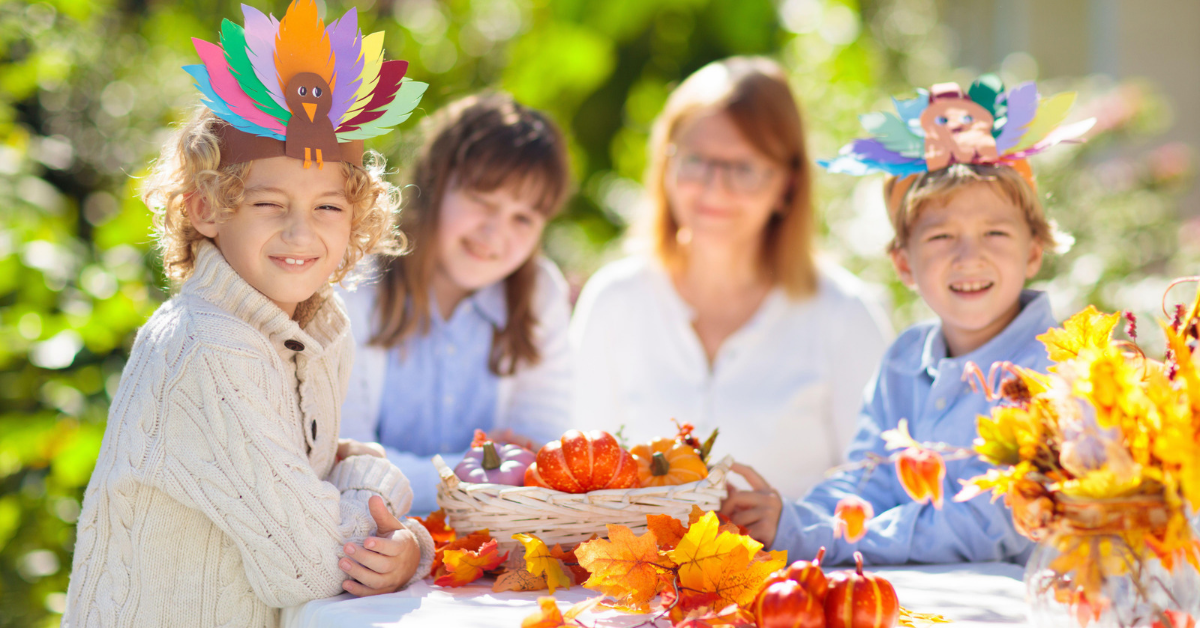
Thanksgiving preparations are full of numbers, measurements, decisions, and spatial problems. A grocery list turns into a budget, recipes become fraction practice, and a crowded table becomes a geometry problem.
For homeschool and classroom instructors, these everyday situations can provide useful real-world math practice without adding another worksheet to an already busy season. The goal is to choose a familiar holiday task, connect it to a skill students are ready to use, and let the math serve a real purpose.
What Are Some Thanksgiving Math Activities for Students?
Thanksgiving math activities can include planning a meal budget, scaling recipes, measuring ingredients, estimating quantities, arranging table seating, and creating geometric crafts. Instructors can adapt each activity to practice skills ranging from basic counting and measurement to fractions, ratios, percentages, and geometry.
Turn Thanksgiving Meal Planning Into a Math Challenge
A Thanksgiving meal creates several practical opportunities for money math.
Give students a pretend budget and a short shopping list:
- Younger students can add whole-dollar prices or compare which item costs more.
- Students ready for decimals can total realistic prices, estimate the final bill, or calculate how much money remains.
- Older students can compare unit prices, adjust quantities for a larger group, or decide which substitutions keep the meal within budget.
Holiday budgeting can extend the activity into estimation, percentages, unit pricing, and real-world spending decisions.
For example, give an older student a fixed grocery budget and a list of ingredients for eight guests. They might estimate the total before calculating it, compare package sizes and unit prices, account for a sale or coupon, and decide where substitutions could keep the meal within budget. One shopping problem can bring several familiar skills together without turning the activity into a worksheet.
Practice Fractions and Measurement With Thanksgiving Kitchen Math
Recipes give fractions an immediate purpose. A student measuring 1/2 cup can see how that amount compares with 1 cup, while doubling or halving a recipe adds multiplication and division to the same hands-on practice.
The Institute of Education Sciences Teaching Fractions Toolkit recommends using real-world contexts and visual representations to support students’ understanding of fraction computation. Measuring cups, spoons, fraction models, or manipulatives can help students connect the calculation with the quantity it represents.
A beginning fraction student might compare 1/2 and 1/4 cup, while a more experienced student could halve 2 1/2 cups or scale a recipe for a different number of servings.
For deeper practice, our fraction recipe activity helps students practice doubling, halving, and scaling with a real recipe.
Use Geometry to Plan the Thanksgiving Table
Setting the table can become a quick geometry and spatial-reasoning challenge.
- Ask younger students to count how many place settings are needed and describe where plates, cups, and utensils belong.
- Students working with measurement can determine whether a table has enough space for each guest.
- Older students can sketch the tabletop to scale, compare rectangular and circular arrangements, or calculate perimeter and area.
Paper placemats, place cards, and centerpieces can also provide practice with symmetry, shapes, angles, and repeated patterns. No formal dining room is required, though. Classroom instructors can use grid paper, desks, paper plates, or a fictional floor plan.
Make Estimation Part of the Preparation
Thanksgiving includes plenty of chances for estimating before calculating.
- How many rolls will the group probably need?
- About how much will five grocery items cost?
- Is one table likely to seat everyone?
- How long might several preparation steps take?
Have students estimate first, explain their reasoning, and then check the result. Comparing the estimate with the actual answer helps students see whether their reasoning was reasonable and where they may need to adjust it.
For additional strategies, the Demme Learning guide to estimation explains rounding, benchmarking, and other ways students can judge whether an answer is reasonable.
Adapt Thanksgiving Math to Student Readiness
The same Thanksgiving activity can look very different depending on a student’s math level. A grocery list, for example, might ask a young learner to count items or compare prices. An elementary student could add the prices and estimate the total, while a middle school student compares unit costs or works within a fixed budget. An older student might factor in percentages, sales, quantities, and substitutions.
The setting stays the same, but the math becomes more sophisticated as the student is ready for it. This allows instructors to use a shared holiday activity without skipping ahead or adding complexity before a student has mastered the underlying skill.
Keep Thanksgiving Math Useful and Low-Pressure
Seasonal math works best when students can see why they are doing it. Instead of asking them to complete unrelated equations printed on a turkey-shaped page, give them a question worth solving.
Demme Learning’s Build, Write, Say approach can fit naturally here. Students can build or perform the situation, write the math that represents it, and say how they reached the answer.
Research on caregiver math talk suggests that everyday conversations can support mathematical thinking. Thanksgiving provides natural opportunities for students to explain an estimate, compare quantities, or talk through how they reached an answer without turning every family activity into a formal lesson.
Make Room for Math at the Thanksgiving Table
Thanksgiving already gives students plenty of reasons to measure, estimate, calculate, compare, and explain their thinking. A grocery list, recipe, or table arrangement can turn familiar math skills into something useful beyond the lesson itself.
Choose one or two activities that fit your students’ skill level. Ask them to estimate, measure, calculate, build, or explain. Then let the answer solve a real holiday problem.
Ready for a seasonal challenge you can use at home or in the classroom? Download The Thanksgiving Math Challenge for more hands-on practice inspired by everyday Thanksgiving moments.
Frequently Asked Questions
Use paper recipes, empty measuring cups, dry manipulatives, or drawings. Students can compare measurements and calculate recipe changes without preparing food. The mathematical objective stays the same.
No. They can serve as a short application, review activity, warm-up, or seasonal project. Use them to give students another way to apply skills they have already been practicing.
Most activities can use materials you already have, such as grocery ads or price lists, measuring cups and spoons, graph paper, play money, rulers, paper plates, or simple printed recipes. Choose materials that support the math skill rather than making the activity more complicated.
Ask the student to explain how they reached an answer or show the calculation that represents what they did. A correct answer is important, but the explanation can reveal whether the student truly grasps the reasoning behind it.

Leave a Reply