



How Money Blocks Use Grouping by Five to Teach Money Concepts
What are Money Blocks designed to teach?
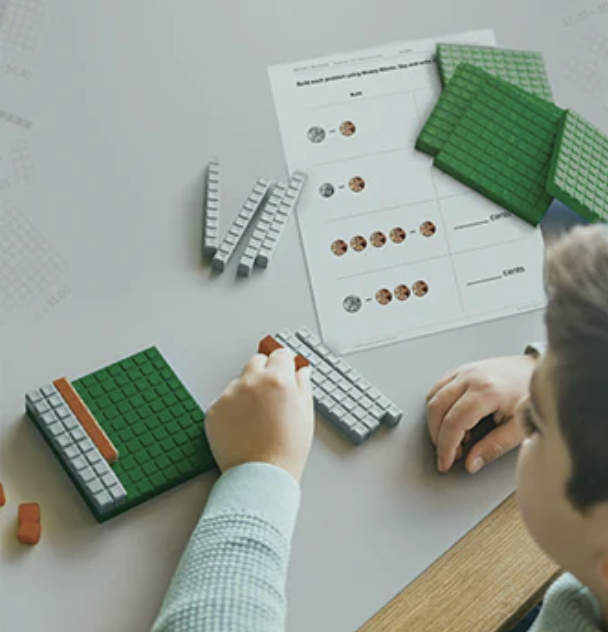
Money Blocks are designed to help students understand how money values are built, not just memorize coin amounts. Instead of asking students to remember that a dime is worth 10 cents or a quarter is worth 25 cents, Money Blocks help students see how those values are grouped and composed using hands-on materials.
This approach reflects Math-U-See’s emphasis on learning with concrete manipulatives, building understanding through practice and review, and building strong mental models that support long-term learning.
Learn more and explore free Money Blocks games and activities available in Early Access.
What does “grouping by five” mean in Money Blocks?
Grouping by five means that values are organized into sets of five before being combined into larger amounts. This helps students focus on relationships between values, rather than counting each unit one at a time. Grouping creates structure, which makes quantities easier to manage and understand.
In Money Blocks, grouping by five is used as a visual and organizational strategy, not as a separate number system or a replacement for base-10 math. Math-U-See continues to teach base-10 place value as the primary structure for mathematics. Money Blocks use grouping by five specifically to support understanding of money.
How does grouping by five connect to real money?
U.S. coins naturally follow patterns that work well with grouping:
| Penny = 1 |  | |
| Nickel = 5 pennies(one group of five) |  |  |
| Dime = 10 pennies (two groups of five) |  | 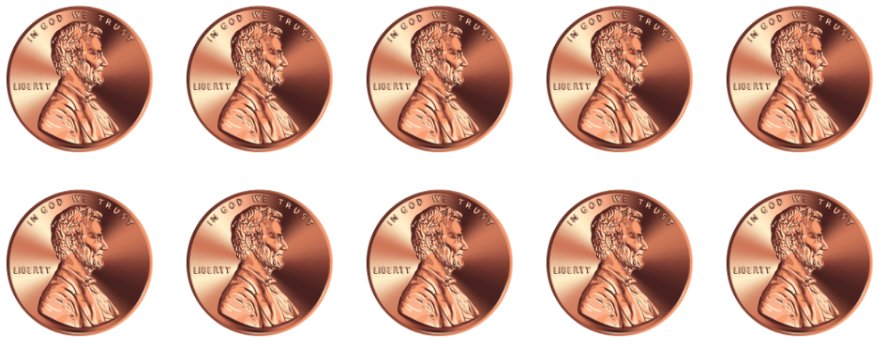 |
| Quarter = 25 pennies (five groups of five) |  |  |
Money Blocks make these relationships visible and hands-on. For example:
The nickel block is arranged as 1 × 5, showing one equal group of five.
|  |
The dime block is arranged as 2 × 5, showing two equal groups of five.
|  |
The quarter block is arranged as 5 × 5, showing five equal groups of five.
|  |
By building these values physically, students can see how coins are related instead of memorizing isolated numbers.
Why does this approach work well for learners?
How Grouping Supports Early Number Sense
Students often learn best when they can see and touch what they are learning. Research in math education shows that organizing quantities into meaningful groups helps reduce cognitive overload and supports stronger number sense. Many students can recognize small groups easily and manage larger quantities by organizing them into familiar patterns rather than counting each unit one by one.
One of the earliest and most natural grouping experiences for learners is associating five fingers on a hand as a single group. Instead of seeing five as five separate items, students begin to recognize it as one complete unit. This early understanding helps students organize larger amounts more efficiently and with less mental effort. As students progress, they naturally extend this idea by recognizing two hands as two groups of five, which together make ten. Seeing ten as two equal groups of five helps students build quantities beyond five without returning to one-by-one counting, reinforcing the idea that larger amounts are made up of smaller, organized groups.
This type of thinking supports skills often described as subitizing and conceptual grouping. When students can quickly recognize groups without counting each item individually, they are better able to combine, compare, and break apart quantities. Groups of five feel familiar and manageable for many learners, especially early on, which helps build confidence as quantities increase.
How Grouping By Five Supports Money Understanding
Using grouping by five with Money Blocks helps students focus on how money values are built and related, rather than memorizing isolated coin amounts. This allows students to move beyond counting one-by-one and develop a clearer understanding of exchange and value relationships.
Grouping money values helps students:
- Count more accurately
- Understand exchange and regrouping
- Build confidence with money concepts
- Transition more smoothly toward base-10 thinking
To learn more about grouping and early number sense, visit:
References
- Clements, D. H. (1999). Subitizing: What is it? Why teach it? National Council of Teachers of Mathematics. https://www.nctm.org/News-and-Calendar/Messages-from-the-President/Archive/J_National_Council_of_Teachers_of_Mathematics/What-Is-Subitizing/
- Starkey, P., & Cooper, R. G. (1995). The development of subitizing in young children. Journal for Research in Mathematics Education. https://www.researchgate.net/publication/228514251_Subitizing_The_Foundation_of_Number_Sense
- Kullberg, A., Björklund, C., & Runesson, U. (2020). Preschoolers’ ways of structuring part–part–whole relations using finger patterns. Journal for Research in Mathematics Education. https://link.springer.com/article/10.1007/s11858-019-01119-8
How is this different from Math-U-See Integer Blocks?
Math-U-See Integer Blocks are designed to teach base-10 place value, with a focus on tens and hundreds as students progress.
Money Blocks serve a different, money-specific purpose.
| Math-U-See Integer Blocks | Math-U-See Money Blocks |
| Teach base-10 place value | Teach how money values are composed |
| Focus on tens and hundreds | Focus on grouping by five |
| Used for general arithmetic | Used for money concepts |
| Core instructional tool | Supplemental, context-specific tool |
Money Blocks are not a replacement for Integer Blocks. They are designed to work alongside Math-U-See materials by helping students understand money before connecting those values back to base-10 notation.
Does this conflict with Math-U-See’s base-10 teaching?
No. Money Blocks are designed to complement Math-U-See instruction, not replace it.
A practical example
A student may first build a quarter as five groups of five using Money Blocks. Later, that same student can write the value as 25 cents and understand why that number makes sense.
Math-U-See continues to teach base-10 place value as the primary structure for mathematics. Money Blocks simply provide a clear starting point for understanding money.
Students are not learning a new number system. They are learning to recognize structure so money concepts feel logical and connected.
When are Money Blocks most helpful?
Money Blocks are especially helpful when students are:
- First learning coin values
- Struggling to understand why coins have different values
- Memorizing without understanding
- Working on early addition and subtraction with money
They are intended to be used as a supplemental tool, alongside Math-U-See instruction and activities.
How do Money Blocks support long-term understanding?
By helping students see how money values are composed, Money Blocks support deeper understanding over time.
Students who understand:
- That a dime is two groups of five
- That a quarter is five groups of five
are better prepared to:
- Compare amounts
- Combine and break apart values
- Move between cents and dollars
- Tackle more abstract money problems later
This supports Math-U-See’s goal of mastery through understanding, rather than memorization alone.